Washington code advisory group narrows scope for temporary emergency shelters, adopts California appendix as working base
Loading...
Summary
The Washington Building Code Council IBC Technical Advisory Group on Dec. 18 focused on defining temporary emergency shelters (hard‑sided cabins/panelized 'pallet' shelters vs. encampments), debated temperature and structural performance thresholds, and voted to use the California appendix as the working base document while preserving local edits.
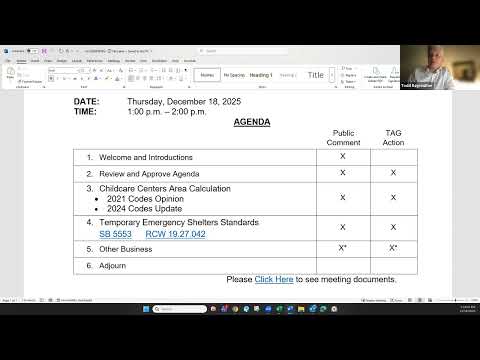
Members of the Washington Building Code Council’s IBC Technical Advisory Group met Dec. 18 to refine guidance on temporary emergency shelters and to decide what the building code should — and should not — regulate. The group agreed to focus the TAG’s work on hard‑sided, panelized sleeping cabins (including so‑called pallet shelters) and similar site‑assembled units, while leaving encampment siting and clustering to land‑use/zoning authorities.
The summary that drove the meeting was simple: clarify which temporary shelters fall under building‑code provisions and which are governed by other laws or by L&I/manufactured‑housing standards. Leila, a strategic adviser in the City of Seattle Human Services Department’s homelessness division, told the TAG that Seattle primarily supports tiny‑house villages and transitional encampments coordinated with the King County Regional Homelessness Authority, and that most recent requests have been for use of empty lots rather than conversions of existing buildings. “We mostly do tiny house villages,” she said, describing HSD’s role as a liaison to permitting staff at the Seattle Department of Construction and Inspections.
Speakers cited three practical categories used in prior local guidance: very small limited‑use shelters (initially discussed as roughly 16–20 beds), a 50‑bed threshold that can trigger different assembly/occupancy rules, and larger shelters up to roughly 100 beds. The TAG indicated those thresholds help determine which building‑code provisions apply, notably for egress, shared‑use sanitation facilities and spacing between freestanding shelter units.
Manufactured units and RV‑type units were excluded from the TAG’s immediate scope. Members noted that park trailers and RVs — commonly governed by L&I or RV/manufactured‑housing standards — generally fall outside the IBC‑driven guidance the TAG intends to write. Aaron Scott of Pallet Shelters described his company’s sleeping cabins as “panelized and fully inspectable on‑site,” adding that hygiene modules sometimes route through L&I depending on jurisdiction. “Nothing is hidden within the walls in the factory,” he said, arguing that on‑site inspection can streamline review and reduce inspector travel.
The group reviewed how tents and temporary membrane structures intersect with the code. Several members observed that Chapter 31 (temporary membrane structures) and pending base‑code changes already address structural loading and some temporary structure provisions; the TAG agreed to avoid creating provisions that conflict with those updates while still ensuring egress and life‑safety coverage are clear.
Heating and minimum‑temperature requirements drew sustained discussion. One member noted an example performance requirement in the building code that aims for interior temperatures of roughly 71°F and asked how an agency would enforce a minimum in temporary settings. Others argued a minimum temperature is a life‑safety concern in cold climates and noted that most tiny‑house villages in Seattle have heating; Tent City encampments were cited as a limited exception. Members discussed making the guidance performance‑based and allowing jurisdictions flexibility for small shelters (for example, modified requirements for very small, short‑term sites).
Structural performance and unit size also received attention. The California appendix the TAG examined uses a 40‑psf live‑load for some temporary sleeping structures and a minimum interior area listed at about 70 square feet; some TAG members suggested 30 psf and smaller modular footprints may be more realistic for many panelized cabins that are intended primarily for sleeping. The group agreed to compare how other jurisdictions and national standards treat live loads, unit size and lofts before finalizing language.
Action and next steps: the TAG voted to adopt the California appendix as the working base document for Washington’s temporary‑shelter guidance, with staff instructed to post a Word version showing proposed strikeouts of sections the TAG may remove or revise. Staff will post local jurisdiction examples and invite members to submit edits ahead of the next meeting. The chair also noted previously tabled work on horizontal separations will remain on the agenda for future discussion.
Votes at a glance • Motion to approve the agenda: moved by Tim Woodard, seconded by Paul Clark; voice vote recorded in favor. • Motion to table item 3 (horizontal separations/opinion): moved by Tim Woodard; seconded by Hoyt Jeter; voice vote recorded to table. • Motion to use the California appendix as the working base document: moved by Tim Woodard; seconded (recorded); voice vote recorded in favor.
The TAG scheduled follow‑up work: staff will post the working document to the TAG web page and collect edits; members noted upcoming meetings in early 2026 to continue work on dwelling‑unit size and the temporary emergency‑shelter appendix.