Get Full Government Meeting Transcripts, Videos, & Alerts Forever!
Get email alerts on the Budget And Enrollment topic
No spam. Unsubscribe anytime.
Board receives year‑end budget briefing and moves school choice window earlier to improve planning
Summary
At its Dec. 10 work session the Seattle Public Schools board got a year‑end financial briefing showing a $97M fund balance after using about $23.7M in FY24/25; staff outlined structural deficit drivers. Enrollment staff also presented a revised school choice timeline, moving open enrollment to Jan. 5–31 and notifications to Feb. 24, with waitlists dissolved May 31 to improve staffing and family planning.
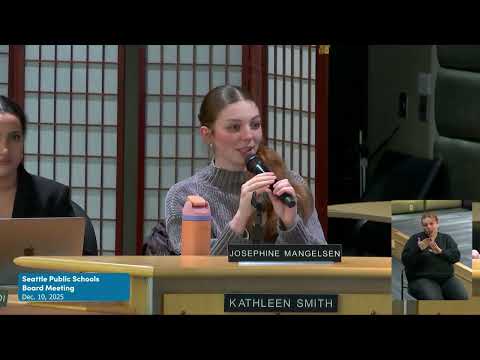
The Seattle Public Schools board on Dec. 10 received a year‑end financial briefing and an enrollment update during a pair of work‑session presentations meant to give new board members a clearer look at district finances and the coming school‑choice timeline.
Year‑end finances: Assistant Superintendent/Chief Financial staff summarized the district F196 year‑end report for fiscal year ending Aug. 31, 2025. Highlights included total general fund expenditures of about $1.195 billion, personnel costs above 80% of operating expenditures, and a fund balance that declined from roughly $180 million in 2021 to about $97 million at the end of FY24/25. Staff said the district used approximately $23.7 million from fund balance to close the year and that state underfunding for special education, multilingual programs and transportation was a major structural driver.
"State funding continues to be the most important," the presenter said, and highlighted that state apportionment and grants together constitute about two‑thirds of district revenue. Staff described a combination of measures used in the past to balance budgets, including reductions, one‑time legislative funding, and interfund loans, and urged that absent structural revenue or expenditure changes, the fund balance will continue to dwindle.
Board members asked for deeper follow‑ups — particularly more detail on special education spending increases, the assigned legal reserve, and capital spending and change‑order context.
Enrollment and school choice timeline: Enrollment staff outlined a revised school‑choice schedule designed to assign students earlier so staffing and budgets can be set with clearer data. The timeline moves the on‑time open‑enrollment window to Jan. 5–31, makes Feb. 1–Mar. 31 a late window, sets assignment notifications on Feb. 24 (earlier than mid‑April), and dissolves all waitlists on May 31 (instead of Aug. 31). Staff said community engagement included seven virtual and five in‑person sessions with more than 450 family attendees and that multilingual interpreters and translated materials were used at events.
Enrollment staff said the goal is to align assignment, budgeting and staffing so schools are staffed to match enrollment rather than the reverse. Directors raised questions about impacts on neighborhood schools, handling of families who move into the district after the deadline, and timelines for highly capable program determinations; staff said they will return with additional details and metrics.
What’s next: Staff said they will provide follow‑up dives in January on department budgets, special education spending, and enrollment projections; board members requested additional materials on legal reserve changes and cumulative change‑order context for capital projects.