Get Full Government Meeting Transcripts, Videos, & Alerts Forever!
Get email alerts on the Awards Child Welfare topic
No spam. Unsubscribe anytime.
Lifetime‑achievement awards honor child‑welfare leaders at Adoption Day
Summary
The Michigan Supreme Court presented the Daniel J. Wright Lifetime Achievement Award to Judge T. J. Acker and the Mora (Maura) Corrigan Award to foster‑parent and caseworker Brooke Frosty, highlighting judicial leadership, mentoring and foster‑care advocacy.
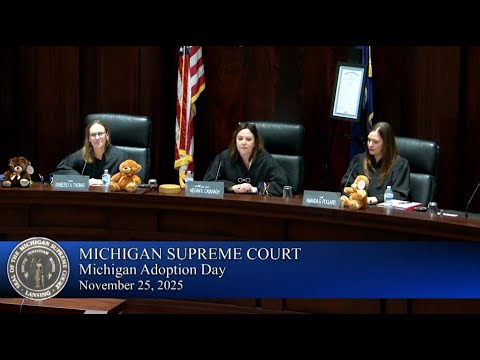
During the Michigan Supreme Court’s Adoption Day program, the court and the Michigan Department of Health and Human Services presented two lifetime‑achievement awards recognizing long‑term contributions to children and families.
The Daniel J. Wright Lifetime Achievement Award was presented to Judge T. J. Acker. Vivek Sankaran, director of the Child Advocacy Law Clinic at the University of Michigan, introduced Acker and recounted examples of his hands‑on approach to youth on his docket, his public advocacy during the 2022 placement crisis and his leadership promoting trauma‑informed programs and efforts to reduce racial bias in court processes. Acker accepted the award, thanked mentors and colleagues, and reflected on the role of judges in improving access to and delivery of justice for children and families.
Former Chief Justice Maura (Mora) Corrigan presented the Corrigan Award to Brooke Frosty, a foster parent and caseworker based in the Upper Peninsula. Corrigan described Frosty’s long‑distance work across the UP and her combined roles as a caseworker and foster parent; Frosty participated by Zoom and thanked nominators and colleagues.
Speakers used the award presentations to call attention to mentorship, systemic improvements and the human commitment behind child‑welfare work. The program highlighted examples of judges and caseworkers who have shaped practices to prioritize children’s needs and advocated for better placement and support systems.
The awards portion of the ceremony underscored both judicial and community leadership in child welfare and connected individual recognition to broader efforts — training, court improvement projects and collaborative forums — intended to improve outcomes for children in foster care.
The ceremony closed with thanks to award presenters and recipients and encouragement to continue cross‑sector work on behalf of children.