Get Full Government Meeting Transcripts, Videos, & Alerts Forever!
Get email alerts on the Landlord Tenant Statute topic
No spam. Unsubscribe anytime.
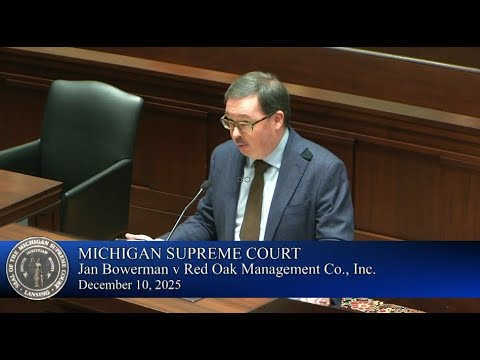
High court hears dispute over contractor liability and scope of landlord-tenant statute in Bowerman v. Red Oak
Summary
At oral argument in Bowerman v. Red Oak Management Co., attorneys disputed whether a contractor that excavated a trench but left the site days before an elderly tenant fell can be held liable and how to define the "common area" under MCL 554.139. Justices probed timing, avoidability and whether statutory "fit" differs from tort reasonableness.
The Supreme Court heard argument in Bowerman v. Red Oak Management Company, a case testing when a contractor or landlord may be held responsible under Michigan’s landlord-tenant statute, MCL 554.139, for hazardous conditions left in a common area.
Plaintiff counsel Christopher Patrick Desmond told the court the trench at issue was created during repairs that the contractor completed on Oct. 21 and that the tenant, JM Bowerman, fell into the same unguarded trench on Oct. 30. "Each of the issues that the court has asked for a supplemental briefing on today is deserving of an opinion from this court," Desmond said, arguing that lower courts have misapplied precedent and that the statute must be "liberally construed" to protect residents who live in facilities reserved for elderly and disabled tenants.
Desmond urged the justices to read the statute’s requirement that common areas be "fit for the use intended by the parties" with an eye to the building’s population. He described Staunton Park as a facility that reserves residency for older or disabled tenants and recounted the plaintiff’s injuries and diary notes documenting persistent hazardous conditions; at argument he summarized the consequence: a 75-year-old woman "army crawling" back to her apartment with a fractured leg.
Counsel for Red Oak Management, Dan James, framed the claim against his client as purely statutory under MCL 554.139 and argued that the relevant common area is the parking lot as a whole. James said the statutory standard of "fit" is a contract-style inquiry—"suitable, adapted, appropriate"—that is distinct from a tort-based reasonableness inquiry, and he urged that isolated, avoidable defects have routinely been resolved as a matter of law in favor of property owners.
Charlene Turner, representing Westfield Services LLC (the contractor that performed the repairs), told the court Westfield completed its contractual work and was off-site when the fall occurred. Turner argued there was no continuing contractual duty obliging the contractor to remain and guard the excavation and emphasized the timing of the incident—nine days after work was finished—as a key distinction from cases where an injury occurs while contractors remain on-site.
Justices pressed both sides on several issues the parties identified as pivotal: (1) how to define the "common area" for purposes of MCL 554.139 (whether the inquiry may focus narrowly on the dumpster/trash disposal zone or should treat the parking lot as a single common area); (2) whether the statute’s directive that terms be "liberally construed" alters the usual open-and-obvious or avoidability defenses; and (3) whether the question of a contractor’s continuing duty after leaving a site is a jury question of reasonable care or a legal question susceptible to summary disposition. One justice asked, "When does Westfeld's responsibility conclude?" and the parties offered competing frameworks tied to timing, contractual scope and the practical visibility of hazards for elderly tenants.
Plaintiff counsel argued that details such as poor visibility at night, the presence of multiple trenches, and testimony that employees called the trench a trip hazard make this a classic factual dispute for a jury. Defense counsel said the limited, avoidable nature of the defect and the contract-oriented "fit" inquiry favor resolving the claim against the tenant as a matter of law.
The court submitted the case after questioning concluded. No decision was announced at argument; the justices will issue an opinion determining the applicable framework for MCL 554.139 claims and the extent, if any, of a contractor’s continuing responsibility after completing work.