Get Full Government Meeting Transcripts, Videos, & Alerts Forever!
Get email alerts on the Miranda Waiver Intoxication topic
No spam. Unsubscribe anytime.
Michigan Supreme Court Hears Challenge to Teen’s Miranda Waiver After Hospital Interview
Summary
At oral argument in People v. Soriano, defense counsel argued that a teenager’s early‑morning statements — made while drugged, half‑naked and strapped to a hospital chair — could not be a knowing Miranda waiver; the prosecutor said trial‑court credibility findings and the totality of circumstances support admissibility. Case submitted for decision.
LANSING — The Michigan Supreme Court heard arguments Tuesday in People v. Soriano over whether a teenager’s statements to police — made in a hospital while the youth was drug‑affected and restrained — were a knowing and voluntary waiver of his Miranda rights.
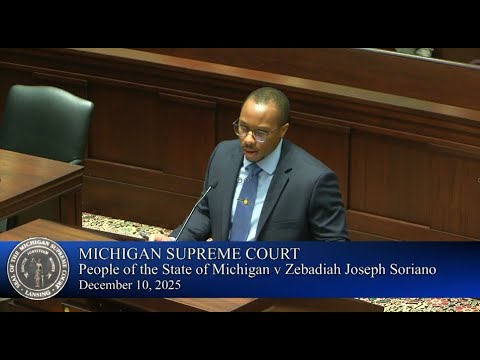
"Courts sitting in The United States should not accept early morning confessions from sleep deprived drugged teenagers who are strapped to chairs," Ali Wright, the state appellate defender representing petitioner Zebedaya Soriano, told the court, urging that the confession be suppressed as involuntary and unconstitutional. Wright said the officer who questioned Soriano knew he had been exposed to winter elements, was half‑naked and was restrained, and that the officer therefore exploited "someone that vulnerable."
Prosecutor Kyle Atwood, arguing for the People of the State of Michigan, told the justices the trial court conducted a full evidentiary hearing, made credibility determinations that were affirmed by the court of appeals, and permissibly concluded the defendant’s statements were admissible. Atwood emphasized that the exchange was a brief, five‑to‑ten minute conversation that the defendant initiated in a hospital setting where restraints had been applied for medical reasons.
Why it matters: The case asks whether courts must treat a custodial statement differently when the speaker is a minor and under the influence of a potent hallucinogen such as LSD, and whether a trial court’s factfinding about the defendant’s coherence and the circumstances of questioning should be reversed.
Defense argument: Wright said the prosecution bears the burden of proving a valid Miranda waiver and that the record lacks evidence Soriano understood his rights or the consequences of waiving them. Counsel highlighted testimony that, two hours after the interview, an officer reported Soriano was "too out of it to actually speak," and said the defendant later exercised his rights when police returned the next day. Wright urged the court to scrutinize the totality of the circumstances — age, intoxication, restraints and limited verbal responsiveness — and to distinguish between a knowing, intelligent waiver and the voluntariness of a confession.
Prosecution argument: Atwood responded that case law requires deference to trial court credibility determinations, and that the short, spontaneous nature of Soriano’s statements — including an early inculpatory remark the prosecutor described as "spontaneous" — supported admissibility. Atwood also argued that Dr. Kara Poland’s expert opinion was inconclusive and likely would not have affected the outcome; he cautioned that requiring an intoxication expert as a precondition for admitting statements would burden routine prosecutions.
Panel questioning focused on several issues: whether a defendant’s simple, non‑criminal questions can permissibly open the door to interrogation without Miranda warnings; whether intoxication from LSD should be treated per se differently from other substances; and whether an officer’s later statement about the defendant’s post‑interrogation condition or the defendant’s acquittal on a separate strangulation charge undermines the trial court’s findings.
At oral argument the defense repeatedly urged that the appropriate remedy was to suppress the statement and stressed that officers could have waited until Soriano was sober and unrestrained. "The answer is just wait," Wright said, arguing that delaying questioning until the teenager was no longer high and no longer strapped to a chair would have avoided the constitutional problem.
The court concluded oral argument and "The case will be submitted," a justice said, leaving the resolution to the justices' conference and opinion process.
The court did not announce a decision; the timing of an opinion was not specified.