Get Full Government Meeting Transcripts, Videos, & Alerts Forever!
Get email alerts on the Statute Of Limitations topic
No spam. Unsubscribe anytime.
High-court oral argument centers on when whistleblower constructive‑discharge claims accrue
Summary
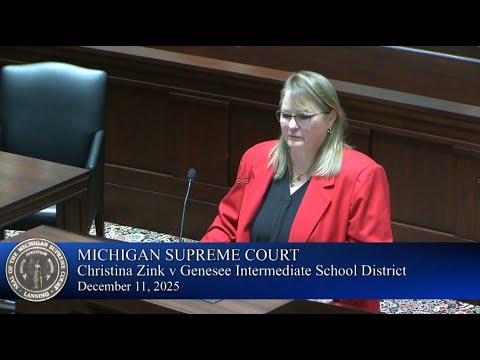
At a mini-oral argument in Zink v. Genesee Intermediate School District, counsel disputed whether a whistleblower constructive‑discharge claim accrues at the employer's last retaliatory act or when the employee resigns; the court took no immediate ruling and submitted the case.
The court heard argument over when a whistleblower constructive‑discharge claim begins to run in Christina Zink v. Genesee Intermediate School District and Jan Cox. Appellant counsel Christine Wasserman told the justices that recent cases following Joliet and McGee have produced “chaos” and argued the statute of limitations should not begin to run until the discharge itself, when the employee is harmed. "The loss surrounding constructive discharge and adverse employment action is chaos," Wasserman said, urging a rule that treats constructive discharge like actual discharge for accrual purposes.
Defense counsel Ken Chappee countered that the plaintiff’s proposal would let plaintiffs “unilaterally control when the statute of limitations on a claim accrues,” effectively tolling time indefinitely. Chappee said the plain language of the Whistleblower Protection Act points to employer acts as the triggering event and urged a bright‑line rule tied to the last employer act. “Her rule that the statute of limitations begins to accrue for a constructive discharge claim when the employee decides to resign … is wrong for multiple reasons,” Chappee said.
The arguments traded largely on statutory text, precedent and policy. Wasserman cited federal authority including Green v. Brennan and asked the court to recognize that an employee suffers the harm of discharge when resignation follows intolerable conditions — such that accrual should run from the date of discharge. She described factual elements the appellant says support constructive discharge in this record: repeated “gaslighting” by supervisor Jan Cox, a transfer from a special‑education role to a PE assignment for which the employee was marginally qualified, and a mediation agreement between district and union. Wasserman acknowledged that prevailing on accrual would not guarantee winning the overall case: the objective reasonable‑person standard governing constructive discharge still requires factual proof.
Chappee emphasized long‑standing state case law treating constructive discharge as a damages enhancer that depends on an underlying actionable employer act and warned of litigation burdens and erosion of the statute of limitations if accrual were tied to resignation. He offered hypothetical bright‑line examples (a severe pay cut or a physical assault) where an employer act clearly would trigger a timely claim but maintained most cases should be tied to the last employer action to preserve evidence and guard against indefinite tolling.
The bench questioned both counsel on how a court should distinguish accrual issues from the merits in highly fact‑specific cases, and how to handle “straw that broke the camel’s back” scenarios where a series of acts culminates in resignation long after earlier events. Justices pressed whether existing precedents like Champion and Jacobson must be overruled or could be distinguished under the Whistleblower Protection Act’s text. Counsel disagreed about the scope of those precedents.
The court did not announce a decision from the bench. After brief rebuttal exchanges, the justices submitted the case for decision.