Get Full Government Meeting Transcripts, Videos, & Alerts Forever!
Get email alerts on the Insurance Rescission Vs Reformation topic
No spam. Unsubscribe anytime.
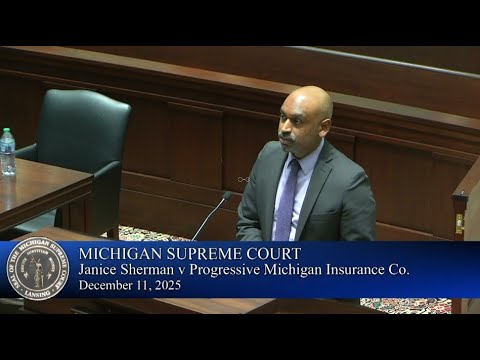
State high court hears arguments on rescission vs. reformation in Sherman v. Progressive
Summary
At oral argument, lawyers for Janice Sherman and Progressive debated whether courts should defer to trial judges’ equitable remedies or apply de novo review to misrepresentation findings, and whether rescission or reformation is the proper remedy given disputed facts about domicile and undisclosed household drivers.
The state Supreme Court on Thursday heard oral argument in Janice Sherman v. Progressive Michigan Insurance Co., a case that asks whether appellate courts should defer to trial judges when they fashion equitable remedies and whether an insurer’s pre-suit rescission is appropriate when an insured made a material misrepresentation.
Plaintiff-appellant counsel told the justices that “rescission is an equitable remedy,” and urged the court to reject what counsel called a de novo approach by the Court of Appeals to the selection of remedy. Counsel outlined “three separate layers” of review — clear error for factual findings, de novo for statutory or contractual interpretation, and abuse of discretion for remedy selection — and said the Court of Appeals erred by taking discretion from the trial court.
The trial court, according to the record described at argument, ordered reformation of the policy to a Detroit address rather than full rescission; the lower court’s oral opinion stated it was “not making a finding as to misrepresentation” while reforming the contract. Counsel for Progressive, Caitlin Kramer, told the justices the factual record was “very well settled” and that there was “no dispute regarding the misrepresentations.” Kramer said the Court of Appeals applied a workable framework — de novo review of misrepresentation and abuse of discretion for remedy — and urged the high court to affirm.
The parties also disputed how to categorize different kinds of application errors. Plaintiff counsel argued that an incorrect mailing or residence address is the kind of mistake that may justify a premium adjustment under policy language, while intentional concealment of prior injuries, licensing status or other material facts affects insurability and merits rescission. Kramer countered that reformation would “reward” misrepresentation and leave Progressive without a full remedy: “reformation does not actually make Progressive whole,” she said, arguing that rescission has been the remedy in this court’s case law and in Court of Appeals panels for material misrepresentations.
Justices questioned both sides about practical consequences. One justice noted that, according to Progressive’s materials, moving a policy from Clinton Township to Detroit could raise premiums by about 75 percent — an issue the parties flagged as relevant background to the remedy the trial court imposed. The Court also explored whether an insurer must seek court approval to rescind: Kramer said insurers commonly rescind pre-suit, refund premiums, and later ask the court to ratify the decision if the insured sues.
Plaintiff counsel pressed the court to allow trial judges the flexibility to weigh life events — such as a house flood that prompted a temporary move — and to protect insureds from losing coverage over circumstances that may have been innocent mistakes. Counsel emphasized equity jurisprudence that permits courts to “mold a decree to do justice amid all the vicissitudes and intricacies of life.”
The case presents two core legal questions: the applicable standard of appellate review when a trial judge crafts an equitable remedy, and whether reformation or rescission should apply where the record contains disputed facts about domicile and the presence of other household drivers. The arguments concluded and the case was submitted to the court for decision.
The justices will now consider briefing and the oral argument record before issuing a written opinion that could affect how lower courts handle insurance applications, premium adjustments and the availability of rescission as a remedy in similar disputes.