Get Full Government Meeting Transcripts, Videos, & Alerts Forever!
Get email alerts on the Short Term Rentals topic
No spam. Unsubscribe anytime.
Decatur planning commission refines short‑term rental rules, agrees on fees, inspections and density study
Summary
In a work session, Decatur City planning commissioners discussed a proposed short‑term rental ordinance and reached preliminary agreements on a $500 total fee (with options for a $100 nonrefundable pre‑fee), required proof of ownership and insurance, annual fire inspections, a 1,000‑foot density rule with possible riverfront exceptions, and a $500 penalty for noncompliance.
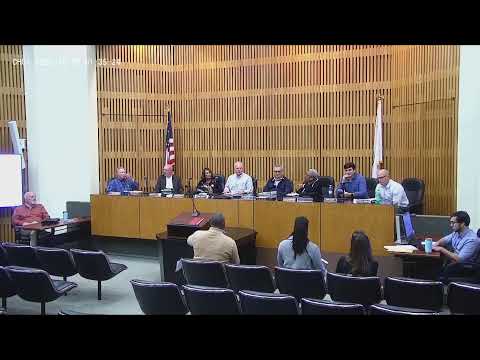
Decatur City planning commissioners met in a work session to refine a proposed short‑term rental ordinance, narrowing options on fees, documentation, inspections and density rules while directing staff to draft legal language for return to the commission.
The commission tentatively supported a fee structure that keeps $500 as the likely total permit cost, with several members favoring a partial nonrefundable up‑front payment to cover city processing. "A $100 application fee nonrefundable. And when approved, they pay the remaining $400," said Speaker 5 during the discussion. Staff also said the earliest step in the process will be a radius check so applicants would not pay fees if they clearly fail the density test.
Why it matters: the ordinance will set the city’s rules for hosting short‑term rentals — affecting neighborhood character, enforcement workload and municipal revenue. Commissioners emphasized balancing life‑safety protections and historic‑home inclusion against administrative burden on staff.
On documentation, the commission agreed that proof of ownership (deed or mortgage/tax statement) and proof of insurance should be mandatory. Commissioners rejected making a utility bill in the owner’s name a universal requirement, noting many rental units have tenant‑held utility accounts or are owned by LLCs. "Proof of insurance and proof of ownership is your mortgage," said Speaker 5.
Safety inspections and re‑registration cycles were a key part of the session. Staff recommended measuring the registration cycle from the approval date rather than the application date and said the fire marshal would conduct annual life‑safety inspections; the ordinance would retain an initial self‑inspection in year one. Commissioners argued inspections should be spread across the year to avoid overburdening building and fire department staff.
Density and geographic exceptions drew the longest debate. The city consultant committee had recommended a 1,000‑foot radius limit (with a maximum per radius); some commissioners advocated a smaller 500‑foot radius to support downtown and waterfront tourism. Staff said tailoring density by zoning or district is legally possible but would require significant research. Several commissioners asked staff to study a riverfront exception bounded roughly by Highway 20 to the river, allowing a different density regime for waterfront and downtown areas.
Other provisions: commissioners endorsed requiring a minimum of two off‑street parking spaces for most short‑term rentals but allowed administrative discretion for historic downtown properties with no on‑site parking. They also endorsed a re‑registration threshold of five nights rented in the prior year. On enforcement, staff emphasized that state/local limits require the ordinance’s penalty cap to be $500; Speaker 2 noted the city had discussed vendor/monitoring costs with Granite, which staff estimated could be roughly $20,000 a year.
Quotes that capture the discussion: "The penalty is $500," said Speaker 2, restating a legally required limit; "We can either apply one density rule going into shifting to different densities for different districts — that'll take a while — and we should at least study the landscape," Speaker 2 added.
What’s next: staff will revise the ordinance text and legalize the wording (including clarifying the administrative exception/appeal path for density), incorporate the agreed‑upon documentation and inspection triggers, and return a draft for formal consideration. No formal motions or votes were taken during this work session.