
Greenville installation: Connolly sworn in, council elects Tanya Forman as mayor pro tem; mayor outlines $48M infrastructure win and '50 in 10' housing plan
Get AI-powered insights, summaries, and transcripts
Subscribe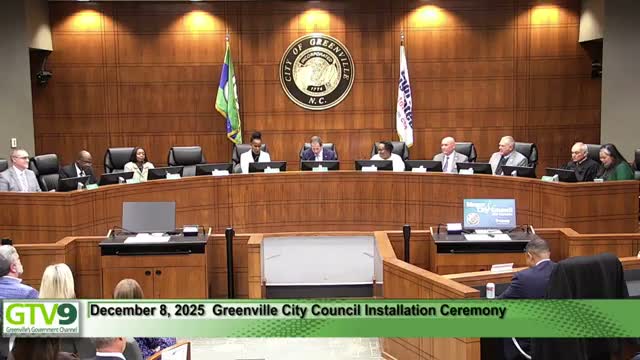
Summary
At Greenville's Dec. 8 installation ceremony, PJ Connolly was sworn in as mayor, the council elected Tanya Forman as mayor pro tem (6-0), and Connolly used his opening address to highlight a completed $48 million build grant, recent street investments and a '50 in 10' affordable-housing initiative.
PJ Connolly was sworn in as mayor of Greenville on Dec. 8 during the city’s installation and organizational meeting, and the newly seated council elected Tanya Forman as mayor pro tem in a 6-0 vote.
The administration and new council took oaths after the Pitt County Board of Elections’ certified results were read by the city manager. Connolly, who presided over the meeting, opened with a speech that emphasized recent infrastructure and economic-development gains and outlined housing and public-safety priorities for the coming term.
Connolly highlighted the completion of a $48,000,000 build grant project that he said transformed key corridors and improved connectivity. "The completion of our $48,000,000 build grant project has transformed key corridors and improved connectivity in ways that will benefit all residents for generations," Connolly said. He also noted growth in street-maintenance spending, saying the city increased annual street work from "a couple $100,000 a year to nearly $4,000,000 this past year," and that the city spent $7,980,000 on 184 streets over the past two years.
On stormwater and resiliency, Connolly said the city has used grants and creative funding to strengthen infrastructure that protects neighborhoods and businesses. He pointed to recent economic-development wins, naming Bovian Solar and NYPRO as recent major employers choosing Greenville, and referenced expansions by other firms.
On housing, Connolly described a public-private partnership tied to the Taft Mills project and introduced the city’s "50 in 10" housing initiative, "aimed at building 50 new affordable housing units in Greenville over the next decade." He framed the initiative as a collaboration with community partners to address affordability.
Connolly also highlighted improvements at Wildwood Park, work on the Town Common bulkhead, and a lease agreement with East Carolina University for the North Campus Complex to develop a sports complex. He credited partnerships among police, community groups and residents for recent reductions in violent and property crime and described recent fire-and-rescue shift-schedule changes designed to help recruitment and retention.
Following the ceremonial and address portions of the meeting, the council conducted its organizational business. Under North Carolina General Statute 168-70, Connolly said, the council must elect a mayor pro tem during its organizational meeting. A council member nominated Tanya Forman; no second was required, and the council voted in favor of Forman 6-0 to serve as mayor pro tem.
The meeting concluded with a motion to adjourn from Council Member Matthew Scully, a second from Mayor Pro Tem Forman and a 6-0 vote to adjourn.
The installation ceremony and organizational meeting brought new and returning members together and set a policy tone emphasizing infrastructure investment, business recruitment and a targeted affordable-housing goal for the coming term. The council adjourned after completing its organizational business.