Get Full Government Meeting Transcripts, Videos, & Alerts Forever!
Get email alerts on the Cdbg Funding topic
No spam. Unsubscribe anytime.
Titusville hears CDBG report as local nonprofits request roughly $118,000 while public-service funds total about $42,000
Summary
City staff presented the FY24–25 CDBG annual performance report and council members heard five nonprofit pitches seeking roughly $118,000 in total; available CDBG public-service funding is about $42,000, and council asked staff for rankings, budget breakdowns and an asset map to guide allocations.
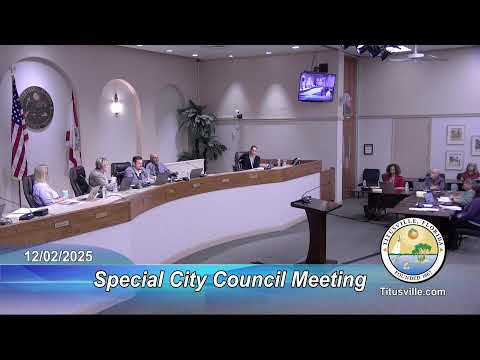
TITUSVILLE — City staff on Monday presented the Community Development Block Grant (CDBG) FY24–25 annual performance report and invited nonprofit applicants to make three- to five-minute funding pitches as the council begins preparing the FY26–27 action plan.
Terry Franklin of Neighborhood Services told the council the city's grant allocation for the previous year was $307,980 and that prior-year funds were $0. "Up to 15% of our annual allocation can be used for public service activities," Franklin said, adding that 20% may be used for administration and that 70% of CDBG funds must benefit low- and moderate-income residents. Franklin said the city spent $437,977 last year, with roughly $39,700 directed to public services and about $336,700 toward neighborhood revitalization projects.
Five applicants described proposed uses: Aging Matters in Brevard sought funds to supplement its Meals on Wheels route in Titusville and asked for roughly $16,000 to provide about 2,860 meals locally at an estimated $5.75 per meal; Brevard Women's Center requested $16,000 to operate a Titusville safe house and advocacy services; Grandparents Raising Grandchildren listed a $7,000 request (no representative present); Matthew's Hope Ministries requested $30,000 for a mobile outreach team that brings buses and outreach staff into Titusville; and North of Our Charities (NBC) outlined a "NBC Power" program and left a request on record that was listed at $42,000 but later described as reduced to $26,000 on agency materials.
Applicants and staff stressed that many programs receive matching funds from county or regional sources. "Most of the programs' budget breakdowns will include other county or municipal support; the city typically supplements rather than fully funds these efforts," Franklin said.
Council members focused on the disparity between requests and available funds. Vice Mayor Cole proposed pro-rating awards so each applicant receives a portion; other members urged staff to compile rankings, provide asset-mapping data being developed by Parish Healthcare, and present program budget breakdowns before final allocations. Member Stoeckle asked whether federal and political changes threaten future CDBG and HOME funding; Franklin said she expects fiscal pressure and said the HOME program could be eliminated next year.
The council did not make final allocations Monday. Staff said it will negotiate with agencies, gather requested data and return in January with funding recommendations and final rankings as part of the FY26–27 process.
The presentation and public pitches were part of the council's broader annual review of housing and community development priorities; the record shows the city carries forward encumbered project funds for continuing work in target areas such as South Street (sidewalks, lighting and transportation improvements).