Get Full Government Meeting Transcripts, Videos, & Alerts Forever!
Get email alerts on the Historic Lighting topic
No spam. Unsubscribe anytime.
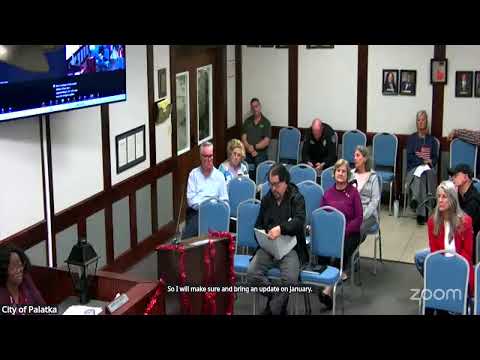
Palatka CRA told TIF can’t pay recurring utility costs; residents urge retaining 17 historic gas lamps
Summary
City attorney told the Palatka CRA on Dec. 8 that Florida statutory changes and AGO guidance bar using CRA/TIF funds for recurring utilities, prompting residents to press the board to preserve 17 historic gas lamps and the board to refer the funding question to the city commission for alternatives.
City of Palatka officials and residents clashed over the future of 17 historic gas street lamps on Dec. 8 after legal staff said Community Redevelopment Agency (CRA) tax-increment funds cannot be used for recurring utility costs.
Attorney West told the CRA that recent changes in Florida law and Attorney General opinions mean CRA/TIF funds cannot be used to pay recurring utilities such as gas, electricity or water, and that the board must reallocate or identify alternate funding if it wants the lamps lit more than seasonally. "Based upon my research and several AGO opinions it is my legal opinion that it cannot," West said during the meeting.
Residents and neighborhood leaders pushed back, saying the lights are integral to the South Historic District’s character. Cheryl Roach said the neighborhood has maintained the fixtures, questioned why the legal interpretation changed, and warned that replacing gas lights with solar fixtures would undermine preservation goals and could bring new costs or theft risks. "If you allow the lights to dim, it proves you are not preserving our unique living environment in our city," Roach said.
Other commenters and board members highlighted practical and financial uncertainties. Staff presented a range of figures during discussion: one staff comment estimated converting or replacing the 17 lamps with a solar option at about $2,500 for the set, while other presenters cited annual gas costs and maintenance in the range of several thousand dollars (staff referenced an estimate of at least $6,200 annually plus ~ $7,000 for repairs and one commissioner cited $12,400 per year). The CRA did not reach a final funding decision but agreed these numbers indicate the expense cannot simply be funded from TIF under current legal guidance.
Given the legal constraint, commissioners discussed other funding mechanisms: using general-fund allocations, transferring money from special-events budgets, or asking the full city commission to consider a funding plan that would not rely on CRA/TIF revenue. A commissioner moved to add the lamp-funding question to the city commission agenda so the full commission could weigh alternatives; that motion passed.
What’s next: The CRA will not use TIF funds to cover recurring utility costs for the lamps under the city attorney’s current legal advice. The matter was referred to the city commission to explore funding outside the CRA and to seek a policy decision. Staff also promised to follow up with the neighborhood on the budget history and to report back on feasible options.