University of Denver expert: climate misinformation deepens inaction; prebunking and trusted local sources can help
Loading...
Summary
Dr. Phil Chen told a League of Women Voters audience that psychology, partisan cues and polished falsehoods drive climate misinformation; he urged prebunking, use of trusted sources (NASA, state universities), and accountability for corporations and politicians. Q&A addressed Colorado-specific reports.
DENVER — Dr. Phil Chen, an associate professor of political science at the University of Denver, told members of the Colorado League of Women Voters that climate misinformation spreads because it fits psychological tendencies and partisan cues and because polished forms (charts, anecdotes and adverts) make false claims look credible.
"Misinformation is beliefs that people think are factual, but that are actually false or contradicted by the best publicly available information," Chen said, laying out distinctions between ignorance, misinformation and deliberate disinformation. He illustrated how a viral anecdote — such as Senator James Inhofe bringing a snowball onto the U.S. Senate floor — can conflate weather and climate and reinforce doubt.
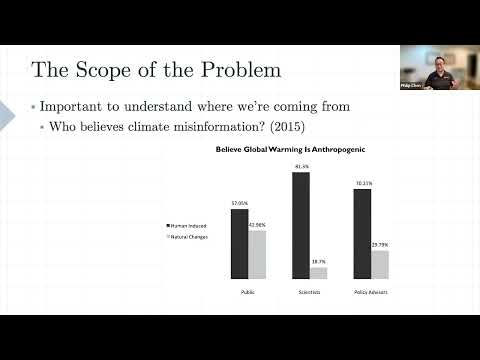
Chen summarized research showing a persistent gap between scientists and the public: "About 90% of scientists believe that global warming is happening, whereas only about 64% of the public believe that it is happening," he said, and he noted near-unanimity among peer‑reviewed climate authors in studies he cited.
But education alone, Chen warned, is not a panacea. Citing social‑psychology research, he said greater knowledge sometimes strengthens people’s ability to argue in line with prior beliefs. "We can't educate our way out of the problem," he said, arguing that better media literacy and prebunking — teaching people to recognize misleading forms before they encounter them — must supplement factual information.
Chen described common persuasive forms used to mislead: "scientific window dressing" (graphs or tables that appear authoritative), emotionally compelling anecdotes, and greenwashing by companies that emphasize small environmental benefits while obscuring larger harms. He urged separating high‑impact actions from low‑impact gestures, noting that measures such as improving home insulation or adopting large‑scale renewable projects often matter more than symbolic acts.
To demonstrate real-world consequences, Chen compared climate misinformation to public resistance to genetically modified crops. He cited a 2017 PLOS One paper (Wessler et al.) that estimated delayed GMO adoption in parts of Africa cost lives and economic output, saying the analogy shows how misinformation can shape policy and public health.
Turning to Colorado, Chen said warming and changing precipitation patterns are already evident in state studies and that those changes exacerbate wildfire risks and other local impacts. He referenced a Colorado Supreme Court decision allowing Boulder’s suit against Exxon and Suncor to proceed as an example of legal action tied to claims about corporate misinformation.
On practical sourcing, Chen recommended tracing claims to primary, trusted outlets — government agencies, peer‑reviewed science and reputable state universities — because advocacy organizations, even when accurate, may not persuade skeptics. "NASA is a good place," he said, and he recommended the Colorado State University climate report for state‑specific projections.
During the audience Q&A, an attendee asked for the physical basis of Chen’s claim about winter increases and summer decreases in precipitation. Chen replied: "I'm not an environmental scientist. The information comes from Colorado State's report on the effects of climate change in Colorado," and he encouraged attendees to consult that report for technical details. He later offered to share his bibliography by email.
Organizers said the recording and materials will be posted on the League’s website and announced a follow‑up talk in the same series on forever chemicals in Colorado.
The meeting closed after roughly an hour of presentation and audience questions, with Chen urging participants not to give in to fatalism and recommending combined approaches — trusted sources, prebunking, accountability measures and meaningful individual and policy actions — to reduce the harms of climate misinformation.