Get Full Government Meeting Transcripts, Videos, & Alerts Forever!
Get email alerts on the Code Amendments topic
No spam. Unsubscribe anytime.
Milwaukie planning commission backs housekeeping zoning package, approves reduced townhouse corner setback
Summary
The Milwaukie Planning Commission voted unanimously to recommend that city council adopt a package of housekeeping amendments to Titles 17 and 19 (file ZA-2025-004). The changes clarify middle-housing rules, ADU and accessory-structure language, wireless facility standards and treat townhouse street-side setbacks on corner lots as side yards to ease development of narrow lots.
The Milwaukie Planning Commission on Tuesday unanimously recommended that the city council adopt a package of code amendments intended largely as clarifications to Titles 17 (land division) and 19 (zoning).
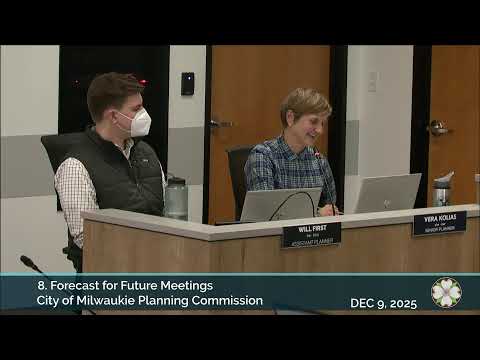
The package, filed as ZA-2025-004, includes a series of edits staff described as "housekeeping" — wording cleanups, cross‑references, and conforming language — along with targeted changes such as adding "or designee" to signing authority, clarifying plat notations for middle‑housing land divisions, updating accessory‑structure rules and aligning manufactured‑housing provisions with state law. Planning Manager Vera Colias told the commission the package was posted with required 30‑day notice and will be heard by city council following the commission's recommendation.
Why it matters: the changes are designed to reduce ambiguity for applicants and staff, speed review, and reflect recent state middle‑housing rules. The commission also endorsed a specific zoning tweak the staff proposed to make townhouse development on narrow, underlying platted corner lots more feasible by treating the street‑side yard as a side yard for townhouses, reducing that setback from 15–20 feet to five feet for the affected townhouse standard.
"Housekeeping amendments are minor code fixes, generally clarifications or minor changes," Colias said during the presentation, explaining the package is not intended to change the meaning or intent of existing regulations. She also cautioned that state rules limit local requirements for middle housing: "we can't require of middle housing anything different than we do for single detached dwellings," she said, which drove the removal of some sustainability and pedestrian‑circulation requirements for middle housing.
Commissioners praised the clarity the package brings and debated several policy questions that staff suggested could be deferred to a later, more substantive package. Vice Chair Lisa Gratrick said the townhouse setback revision stood out: "I like the idea of seeing land be used appropriately, and I like the idea of seeing us get more units," she said, describing the change as a tool to unlock housing potential on narrow corner lots while relying on existing facade articulation standards to avoid blank walls.
Several commissioners asked staff to separate or revisit language that would allow attached cottages and to study whether vertical "stacked" cottages should be permitted. Staff said cottages were intended to be detached or side‑by‑side when attached and that allowing stacked cottages raises separate policy and land‑division issues.
Other notable edits in the package include: clarifying ADU treatment for detached structures (800‑square‑foot limits and footprint rules), updating small‑cell wireless facility language to reflect FCC guidance and adding small‑cell standards for the public right‑of‑way, correcting flag‑lot driveway width math, and removing obsolete references to a dissolved Design and Landmarks Committee.
The commission voted to recommend approval on a motion to "approve the Type 5 code amendments as they're recommended by staff." Vera Colias called a roll‑call vote: Vice Chair Lisa Gratrick — Aye; Commissioner Hess — Aye; Commissioner Lather — Aye; Commissioner Penick — Aye; Commissioner Sherman — absent; Commissioner Colin Steer — Aye; Chair Joseph Edge — Aye. The recommendation to council passed unanimously among present members.
Next steps: the commission's action is a recommendation; city council will hold the final public hearing and decision. Staff noted the council hearing is tentatively scheduled in January and advised applicants to consult planning staff for details on the council hearing date and process.