Get Full Government Meeting Transcripts, Videos, & Alerts Forever!
Get email alerts on the Police Contracts And Care topic
No spam. Unsubscribe anytime.
Council briefed on SPOG and SPMA contracts that would expand CARE solo dispatch, increase wages and change accountability negotiations
Summary
Central staff presented proposed collective bargaining agreements with the Seattle Police Officers Guild and Seattle Police Management Association that would authorize wages increases, expand civilianization and CARE solo dispatch in specified situations, and leave key accountability issues (appeals standard, subpoenas) for arbitration or future bargaining.
City staff on Monday walked Seattle City Council members through proposed collective bargaining agreements with the Seattle Police Officers Guild (SPOG) and the Seattle Police Management Association (SPMA) covering 2024–2027, highlighting accountability reforms, a path to expanded community-response capacity and multi-year fiscal impacts.
Greg Dawson of council central staff said the SPOG contract (Council Bill 121,133) would be effective Jan. 1, 2024, through Dec. 31, 2027. "The Seattle Police Officers Guild contract between the city and SPOG is effective from 01/01/2024 to 12/31/2027," Dawson said during his presentation, and he described negotiated changes designed to address long-standing accountability priorities raised by the Office of Police Accountability (OPA), the Office of Inspector General (OIG) and the Community Police Commission.
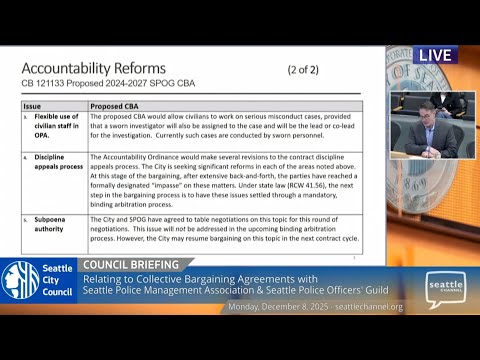
Dawson summarized five accountability priorities that the accountability agencies prioritized: allowing sergeants to conduct frontline investigations of minor misconduct (to prevent low-level matters from overwhelming OPA); clarifying when the 180-day investigative timeline begins (aligning it with when OPA receives or initiates a complaint); permitting civilian investigators to work on serious cases when sworn investigators co-lead; resolving disputes over the discipline-appeals standard (currently resolved through PERC arbitration and de novo review); and subpoena authority, which the parties tabled for later bargaining.
On alternative response, Dawson said the proposed contract would remove the cap on the number of CARE (community crisis responders) staff and permit sole dispatch of CARE responders in defined, lower-risk situations (behavioral-health crises, requests for shelter/transportation/food, visible checks for safety). He and multiple council members described that change as the key operational step that would allow CARE to scale: staff estimate CARE could respond to many more calls and that the program will grow from current staffing toward 48 responders, enabling tens of thousands more potential responses under the new criteria.
The agreement also includes compensation changes: a language premium of 1.5% for some qualifications and up to 4% for a bachelor's degree, and annual wage increases of about 6% (2024), 4.1% (2025) and 2.7% (2026) with 2027 tied to CPI (floor 3%–4%). Dawson presented estimated incremental costs of roughly $12 million in 2024, $22 million in 2025, $42 million in 2026 and $53 million in 2027; the City Budget Office has reserved funds to cover costs through 2026, while 2027 implications will be addressed in the next budget cycle and a midyear appropriations bill would fund retroactive pay.
Council members thanked staff for the detailed memos and voiced both support and caution. Councilmember Kettle said the contract is a major step for accountability and workforce development but noted that some accountability items (subpoenas, appeals standards) remain unresolved and may require arbitration or state legislative changes. Councilmember Lin expressed concern that bargaining necessarily keeps many negotiation details confidential and asked staff to highlight where public input can be made; staff pointed to required LRPC and public safety committee hearings that happen before formal bargaining cycles and noted that state law requires confidentiality during negotiations.
No final vote was taken at the briefing; council members heard the presentations and were reminded the full council will consider the ordinances and receive public comment at the next meeting. Staff noted that SPMA's contract (captains and lieutenants) incorporates many similar reforms and in some areas has already implemented measures such as subpoena authority and a preponderance-of-the-evidence standard for discipline appeals.