Get Full Government Meeting Transcripts, Videos, & Alerts Forever!
Get email alerts on the Public Safety Surveillance topic
No spam. Unsubscribe anytime.
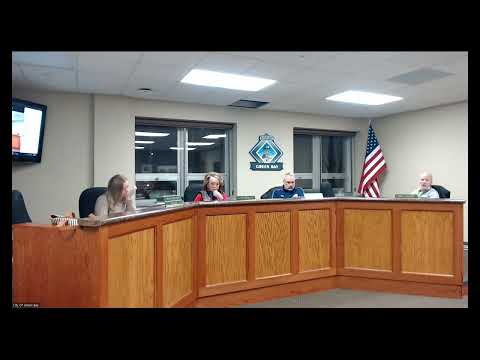
Green Bay panel approves Flock drone‑first responder program amid staffing and privacy questions
Summary
The Green Bay Finance Committee approved a multi‑year agreement to add Flock’s integrated license‑plate readers and a drone‑as‑first‑responder program, with vendor presenters estimating the drones could be used on roughly half of annual calls; members pressed for deployment criteria, staffing and metrics before funding moves to the levy.
The Green Bay Finance Committee on Dec. 9 approved an agreement with a vendor to add an integrated surveillance camera system and a drone‑as‑first‑responder (DFR) capability for police and fire use, part of a multi‑year subscription model the city will test this year.
The committee’s discussion centered on how the technology would be used and paid for, not on whether to pilot it: the motion to approve the agreement passed unanimously after extended Q&A. Chief (unnamed in the transcript), who described staffing and operational limits, said the technology would allow officers to get “eyes on” a scene quickly and cancel unnecessary responses in cases such as false crash‑sensor 911 calls. “If we can send a drone to get overhead in a few minutes, see there’s nothing there, we can cancel all of that response that’s coming,” the chief said during the presentation.
Vendor representatives from Flock described the product and the company’s analysis of the city’s call data. Ryan Mertz, the account executive and project lead, told the committee that the system is designed to integrate with Green Bay’s CAD and ALPR (automated license plate reader) systems and that initial deployment maps identified two docking sites covering roughly a 3.5‑mile radius each. Seth Hutcherson, director of aviation for the vendor, said the company estimated the drone could be used on “roughly half” of the city’s calls for service — about 36,000 of approximately 68,000 calls by their calculation — and that about 4,200 of those calls could be cleared without a ground response depending on local policy.
Committee members pressed the chief and vendor on several operational points: who will control drone deployment, what criteria will trigger a launch, whether drones will delay responses to high‑risk calls, how operators will be assigned, and whether the program will create overtime or specialty‑unit staffing pressure. The chief said drones would be launched concurrently with ground units when warranted and that the city will set local deployment standards: “We’re not gonna wait to send people who could potentially help just so we can get it out,” the chief said.
Cost and funding were also focal points. Committee members referenced vendor ROI figures and an annual levy impact estimate of roughly $270,000 to $300,000 in out‑years; the chief said the first year would be paid with leftover ARPA funds and that future years would likely move to the general fund. Vendor representatives said the subscription model includes equipment, upgrades, maintenance and training.
Some alderpersons asked for measurable outcomes to justify the investment. One member suggested a dashboard tracking traffic‑safety activity and other local metrics to demonstrate value, and the chief acknowledged the need for public transparency on expected benefits. The committee did not adopt specific performance conditions before approval, but members repeatedly asked staff to return measurable outcomes and usage metrics as the program is implemented.
The agreement the committee approved bundles camera services (including discounts on existing ALPR cameras) and the drone subscription; vendor presenters said the system supports thermal imaging, autonomous flight routing from CAD inputs and integration with ALPR alerts to aid real‑time response. The committee’s vote sends the agreement forward for implementation and directs staff to return with operational details and metrics as the program is stood up.