Get Full Government Meeting Transcripts, Videos, & Alerts Forever!
Get email alerts on the East Bank Boulevard topic
No spam. Unsubscribe anytime.
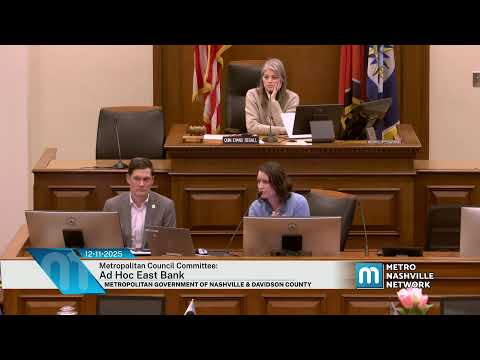
Administration outlines East Bank Boulevard design approach, flags NEPA, FEMA and phasing to 2037
Summary
City staff described a phased, context-sensitive design process for the East Bank Boulevard tied to the 'Choose How You Move' transit program; presenters warned that NEPA changes, FEMA floodplain maps and recent rezonings (scrapyard sale, Oracle updates) affect design timing and federal funding eligibility, and said some elements may not be complete until about 2037.
Michael Briggs, deputy chief program officer for the Choose How You Move program, explained how the East Bank Boulevard fits into the city's all-access corridor network and tied street-design decisions to the voter-approved Choose How You Move transit investments. Briggs emphasized the program's community-engagement approach and said no final cross section has been chosen.
"No final decision has been made on the boulevard cross section at this point," Briggs said, stressing that design will be context-dependent and phased. He said the corridor is intended to support dedicated transit lanes, wide sidewalks, protected bike facilities and placemaking over time.
Anna Greider, chief operating officer of the East Bank Development Authority, listed factors complicating the timetable: a major rezoning and sale of a former scrapyard, Oracle's updated renderings that imply different trip generation, pending FEMA floodplain map adoption (based on US Army Corps recommendations), and evolving NEPA guidance at the federal level that could complicate grant eligibility and the schedule for environmental review.
Greider said staff are conducting trip-generation analysis for 2035 and 2055 horizons using a 60/40 mode-split assumption (60% single-occupancy vehicles, 40% other modes) and that much of the non-boulevard infrastructure (protected bike lanes, greenways) will be built earlier. She highlighted active work on South 2nd Street (protected bike lanes and wide sidewalks) and a Riverfront Greenway segment near River North expected to open within a week.
Briggs and Greider described a phased "continuous improvement" approach: interim operational improvements (signal upgrades, temporary curb uses) can be deployed as context evolves, with final buildout occurring over many years. The presentation included a projected timeline in which major corridor components may not be fully realized until about 2037; interim improvements and grant-seeking activities will be used to preserve funding eligibility.
Council members asked about extending the Greenway beyond Vashti and whether bike lanes remain part of the boulevard cross section; staff said extensions beyond EBDA's official area require coordination with planning and state partners and that a phased, flexible approach could retain bike lanes or other curbside uses depending on context. No final cross section, contract or construction schedule was adopted at the meeting.