Get AI Briefings, Transcripts & Alerts on Local & National Government Meetings — Forever.
Kyrene board weighs narrower closure plans, asks administration for three alternative maps ahead of Dec. 16 vote
Loading...
Summary
After administrators outlined enrollment projections and budget scenarios, the Kyrene School District governing board asked the superintendent to return with three map options — the current 6‑elementary/2‑middle proposal, a 5‑elementary/0‑middle option and a 4‑elementary/2‑middle option — and to apply objective criteria to the six elementary schools now slated for closure.
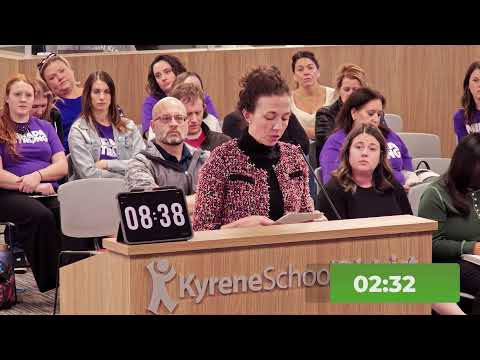
The Kyrene School District governing board spent its Dec. 2 study session debating how many schools to close and how best to protect core programs and families before a likely vote at its Dec. 16 meeting.
President Kevin Walsh opened the session by reminding the board: "There's no vote that's happening tonight," and that any guidance to the superintendent must be specific — for example, how many schools to close and what objective criteria to apply. Superintendent Tenney and district staff reviewed the schedule for boundary and enrollment decisions and said families need clarity in time for the district's February enrollment window.
District leaders and school practitioners framed the debate around both student experience and dollars. Dr. Garth Kupp and several principals and teachers described operational constraints at under-enrolled campuses — limited specialist time, multi‑prep teachers, part‑time assistant principals and compressed master schedules that reduce elective and intervention opportunities. "When you're a smaller school the specials ... go to larger schools and then the smaller schools we get what's left over," Estrella academic interventionist Holly Cook said.
Chief financial staffer Mr. Herman walked through five‑year enrollment projections and several closure scenarios, warning the board of uncertainty in any estimate. Using the district's demographer projections, the presentation showed an expected net loss of roughly 1,100 students over five years and noted that the district would need about $6.7 million in permanent reductions over that period if nothing changes. Herman illustrated year‑by‑year impacts (for example, a projected 310‑student shortfall equating to roughly $1.9 million in state funding lost in year one) and presented tables converting student losses to ADM (average daily membership) and dollars.
Herman and the superintendent also walked the board through three levers used historically to balance budgets — attrition and operational efficiencies (levers 1 and 2) and deeper program reductions (lever 3) — and quantified personnel savings under various closure counts. "If you close four elementary schools, that would generate about $2,000,000 of personnel savings," he said, while also warning that any enrollment leakage triggered by closures could offset those savings.
Board members voiced competing concerns. Several members said doing nothing risks continued erosion of student programming and staff capacity; others worried that large, rapid closures could spur family withdrawals that worsen the fiscal gap. "Closing eight schools all at once might achieve efficiencies, it might not," President Walsh said. "If it ends up being more loss than anticipated, that would be a very disruptive financial impact."
After extended discussion, the board directed Superintendent Tenney to return with three maps and associated analyses before the Dec. 16 vote: (1) the current recommendation presented at public hearings (6 elementary, 2 middle schools proposed for closure), (2) a model keeping both middle schools open and closing five elementary schools, and (3) a model closing two middle schools and four elementary schools. For the elementary selection, the board asked the administration to apply objective, measurable criteria to rank the six schools currently proposed for closure — specifically: (a) number and percent of home‑boundary students at the school, (b) home‑boundary utilization percent, and (c) overall enrollment as a tiebreaker.
Public comment underscored the stakes. Parents and community members warned that closure notices can prompt district‑wide attrition, citing cases where districts lost far more students than demographers predicted; several speakers urged the board to require detailed, validated operational plans, special‑education continuity plans and leakage modeling before final votes. Teachers and some site leaders urged quicker certainty to reduce staff turnover and allow school leaders to plan.
Procedurally, the governing board approved routine agenda and consent items by unanimous 5‑0 votes during the regular meeting that followed the study session, then adjourned at 8:41 p.m.
Next steps: the superintendent will work with the demographer to produce the three alternative maps and a ranked application of the elementary criteria and will present those publicly to the board before the scheduled Dec. 16 meeting.