Get Full Government Meeting Transcripts, Videos, & Alerts Forever!
Get email alerts on the Education Report Card topic
No spam. Unsubscribe anytime.
Randolph County Schools posts C on state report card, shows gains in growth and graduation rates
Summary
District officials told the board the district score is 75 (C) with strong academic growth (96.88) and a near‑90% graduation rate; schools across the district showed mixed results and chronic absenteeism remains a focus.
Miss Braden (Speaker 1), presenting the state report card to the Randolph County Board of Education, said the district’s initial state report card score was 75 — a C — and highlighted areas of strength and focus across schools. “Our initial score was a 75 and it was a c,” Braden said.
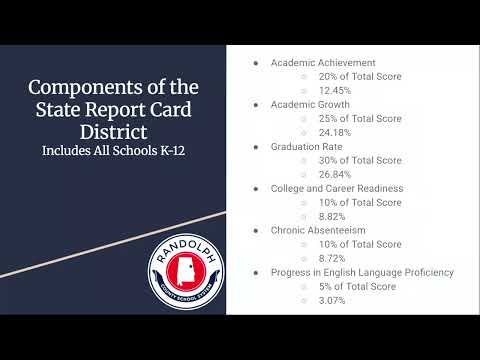
Braden explained how the state score is calculated and where the district performed: academic growth counts for 25 percent of the total, graduation rate 30 percent, college and career readiness 10 percent, chronic absenteeism 10 percent and progress in English‑learner proficiency 5 percent. She noted the district’s academic growth score was 96.88 and the combined graduation rate across the district’s three high schools was 89.47. “College and career readiness, our score is 88.16,” Braden added.
The presentation included school‑level breakdowns. Braden highlighted that Randolph County High School increased in several areas and that Rock Mills Junior High recorded an academic growth score above 98 with the district’s lowest chronic absenteeism. She said Widow Elementary was among the state’s most improved schools, jumping from 66 to 89, and Woodland Elementary and Winaly Middle School each posted academic growth measures of 100. Braden noted Woodland High School had the district’s highest graduation rate for 02/24/25 at 93.18.
Braden emphasized chronic absenteeism’s weight on report card outcomes and clarified the term as students with 18 or more absences in a school year. She also pointed board members to the state’s public reporting site for detailed school and district comparisons and offered to answer follow‑up questions.
Why it matters: The state report card informs public accountability and identifies schools that may need additional state support or district interventions. Board members did not take action on the ratings themselves but discussed next steps in curriculum and attendance strategies.