
Planning Commission upholds truck-repair permit in Southwest Fresno after appeal; adds condition on onsite residence
Get AI-powered insights, summaries, and transcripts
Sign Up Free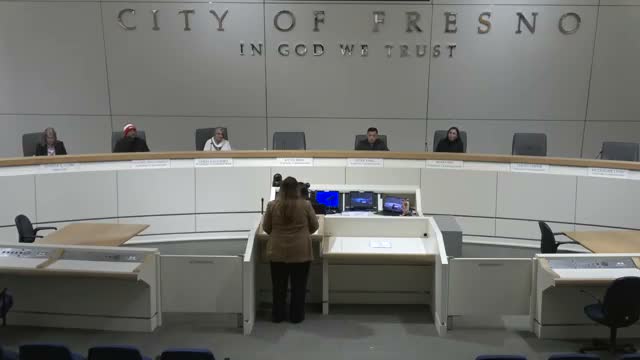
Summary
The Planning Commission denied an appeal of Development Permit P23-03606 for a 4,900-square-foot truck repair shop at 121 West North Avenue, concluding the proposal meets Business Park zone standards and air-quality and traffic mitigation conditions; commissioners added a condition that the onsite residence not be used as a dwelling.
The Fresno City Planning Commission on July 22 denied an appeal and upheld the director—s approval of Development Permit P23-03606, allowing construction of a 4,900-square-foot truck repair shop on a 2.23-acre parcel at 121 West North Avenue. The commission added a condition that the onsite residence not be used as a dwelling.
Planner Britney Martin summarized staff findings: the property is in the Business Park Zone and the proposed repair shop, with three service bays and nine designated commercial truck parking spaces, conforms to applicable development standards when conditioned. Staff said the project operates 8 a.m. to 6 p.m., includes landscape buffering (30-foot buffer on the west), screened storage and is subject to the San Joaquin Valley Air Pollution Control District—s review. The staff report and environmental assessment concluded emissions would remain below district thresholds and that additional mitigation (vegetative barriers and idling minimization) would be required as conditions.
Several residents and community leaders opposed the project during public comment. Michael N. Lewis said decades-long exposures to truck activity and pollution in Southwest Fresno mean residents deserve more protection; Pastor B.T. Lewis testified that trees have not solved the area's air-quality problems and urged the commission to apply "special care" given documented health disparities. "We are being murdered in that area with pollution," the pastor said, describing systemic neighborhood impacts.
Applicant representatives, including Alvia Lopez of Central Valley Engineering and project manager Nick Sahota, said the team had worked with staff for two years, provided a vehicle-miles-traveled report and reduced onsite truck parking from an earlier design to nine commercial spaces to address neighborhood concerns. Sahota said the project is consistent with the 2016 citywide rezoning that designated this parcel for business-park uses and that a VMT analysis and public-works review found the existing roadway network can accommodate the anticipated traffic.
Commissioners debated whether they could make the required development-permit findings in light of community testimony about narrow streets, mailbox damage from passing trucks and cumulative air-quality burdens. One motion to approve the appeal (which would have denied the permit) failed. A subsequent motion to deny the appeal and uphold the director—s approval passed; commissioners added a condition barring use of the onsite residence as a dwelling and noted standard appeal channels to council or the mayor remain available.
The director—s approval includes conditions to minimize truck idling, require screening and buffering, and call for coordination with the air district where applicable. The commission urged enforcement of those conditions and offered to set up individualized staff briefings for commissioners on findings and procedural requirements.