CB2 endorses Canal Street redesign, urges DOT to address sidewalk extensions, vending and deliveries
Loading...
Summary
Manhattan Community Board 2 unanimously approved a resolution supporting NYC DOT's Canal Street redesign while urging specific changes: expanded curb extensions and daylighting, protection near subway elevators, planting medians and coordinated enforcement to address illegal sidewalk vending and delivery impacts.
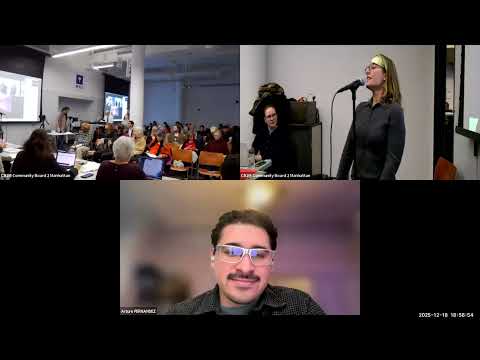
Manhattan Community Board 2 on Tuesday voted to support the New York City Department of Transportation’s Canal Street redesign — but with a string of required changes and clarifications aimed at protecting Chinatown businesses, improving safety and making bike connections more reliable. The resolution, read into the record by Janine Kiley during the Traffic & Transportation committee report, passed after board members pressed for more detail.
The board’s resolution said, in part, “Manhattan Community Board 2 strongly supports NYC DOT’s Canal Street redesign goals and proposed plan to improve pedestrian safety, rebalance vehicle space, and improve bicycle connectivity.” It then listed targeted requests: painted curb extensions at the northwest corner of Hudson and Canal; hardened daylighting at intersections; prioritized curb extensions where subway elevators exist; a planted center median to shorten crossings and allow greening; and a cross‑town protected bike lane linking the Manhattan Bridge to the Hudson River Greenway.
Why it matters: Canal Street is both a major pedestrian corridor and a commercial spine that serves restaurants, banks, medical offices and the Chinatown community. Several board members and public commenters said DOT’s high‑level plans lacked block‑by‑block measurements and did not show how commercial deliveries or longstanding illegal sidewalk vending would be handled if vehicle lanes were narrowed.
Janine Kiley, the committee presenter, said the resolution asks DOT to “coordinate adding, extending the sidewalk simultaneously with NYPD, the Department of Consumer and Worker Protection, the Department of Sanitation, and other city agencies to address ground‑floor businesses illegally displaying their goods on the sidewalk.” In discussion, she acknowledged DOT’s plans did not include detailed sidewalk‑width numbers for every block and asked the agency to return with more granular data.
Residents and business advocates also spoke during public comment. Eleanor Wong of Chinatown told the board she feared proposed sidewalk extensions would hurt delivery logistics and senior patients who travel to local medical offices: “If no parking is very inconvenient” and narrow side streets can’t accommodate deliveries, Wong said, urging the board to “treat Chinatown as a unique neighborhood.”
Board members pressed two practical concerns: how wide extensions would be at each block and how enforcement against sidewalk vending would be coordinated with any curb changes. The resolution requires DOT to explain why sidewalk extensions were proposed for only some Canal Street segments and asks DOT to present more detailed options and delivery mitigations.
The board called the question after discussion and the resolution passed. Next steps: the resolution will be forwarded to DOT and included in CB2’s comments on the Canal Street redesign; the board asked DOT to return with block‑level measurements and an enforcement plan addressing vending and deliveries.