Get Full Government Meeting Transcripts, Videos, & Alerts Forever!
Get email alerts on the Public Safety Grant Mou topic
No spam. Unsubscribe anytime.
Nashville council defers vote on downtown public‑safety MOU after heated debate over surveillance and oversight
Summary
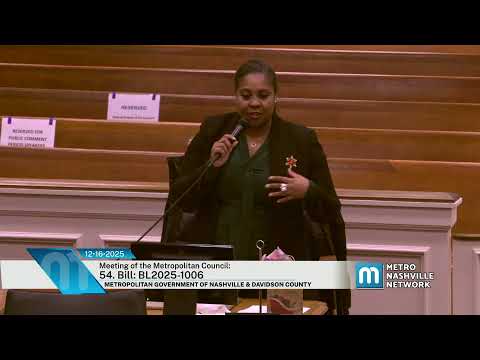
After hours of public testimony and council debate about surveillance, transparency and who controls grant funds, the Metro Council voted 19–17 to defer a memorandum of understanding with the Nashville Downtown Partnership until Jan. 20 so members can seek further clarifications and amended language.
The Metropolitan Council on Tuesday delayed action on a proposed agreement between Metro government and the Nashville Downtown Partnership (NDP) tied to a state FY‑26 downtown public‑safety grant, after public commenters and council members raised concerns about surveillance, governance and public hearing requirements.
Council members approved a one‑meeting deferral, 19–17, moving the resolution to the Council’s Jan. 20 meeting. The item had been amended repeatedly on the floor, and sponsors and special counsel circulated revised versions of the memorandum of understanding during debate.
Supporters of amendments said they intended to preserve Metro oversight and require that any surveillance technology donated to or acquired by Metro be subject to existing Metro code public‑hearing requirements. Special Counsel Margaret Darby told the chamber that Metro Code of Laws section 13.08.080 requires a public hearing for actions that include entering agreements, accepting funds, acquiring new surveillance technology, or acquiring data captured by such systems. “If any of those donations or gifts involved surveillance technology, then there would need to be a public hearing before the council as well,” Darby said on the record.
Opponents — including scores of public speakers during the comment period — argued the MOU effectively transfers oversight and control to private partners and could expand surveillance tools downtown. “This MOU follows that same pattern. It shifts public authority into private hands and expands the machinery used to control the very people displaced by your agenda,” Craig Barto, a public commenter, told the Council during public comment.
Council debate focused on two interlocking concerns: whether funds routed through the NDP would allow the city to retain meaningful oversight over purchases and operations, and whether the MOU’s original language permitted the acquisition or use of surveillance systems without a council public hearing. Several members pressed for clear language that Metro installation of cameras and any acceptance of surveillance technology would be subject to Council approval and the public‑hearing process described in Metro code.
Sponsor Council Member Toombs and others introduced and won amendments intended to clarify the text, require compliance with federal, state and local law (including §13.08.080), and specify that cameras installed would be installed by Metro. Nevertheless, members argued over whether those changes were sufficient. Some members worried that a simple deferral would let the Downtown Partnership accept or spend grant funds before the Council’s next meeting.
Mayor’s Office staff and administration representative David Rosenberg told the Council they could not speak for the NDP’s internal decisions but explained that the grant could be awarded to either Metro or a qualified private entity and that, depending on the recipient, different rules could apply. Several council members urged the mayor’s office to seek a formal commitment from NDP that it would not spend funds or accept surveillance equipment before the Council’s January meeting.
The Council’s one‑meeting deferral requires the administration and NDP to return with revised language and further documentation; the item will appear on the Jan. 20 agenda.
What’s next: The Council scheduled further consideration for Jan. 20, 2026. If the parties propose additional changes, the Council will have an opportunity to debate amendments and seek public input between now and then.