Get Full Government Meeting Transcripts, Videos, & Alerts Forever!
Get email alerts on the Economic Development Tax topic
No spam. Unsubscribe anytime.
Monroe County staff seeks flexible two-year EDIT capital plan amid debate over funding a justice center
Summary
County staff told commissioners they must submit a capital improvement plan covering at least 75% of projected economic development income tax (EDIT) receipts for 2026'27. Commissioners and council members debated reserving EDIT funds for a justice center versus alternative projects such as airport improvements, housing infrastructure, transit or initial fire consolidation costs.
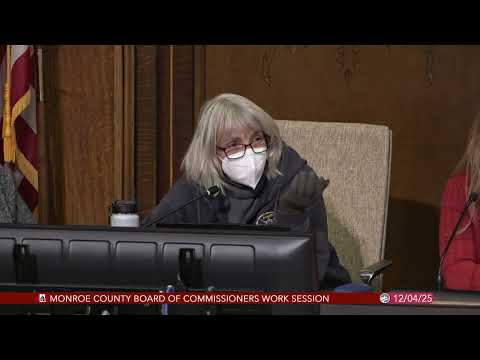
County staff and commissioners met Dec. 4 to begin drafting a capital improvement plan tied to the county's economic development income tax (EDIT), with staff warning that state law requires the plan to account for at least 75% of projected EDIT revenue over the plan period.
"The plan has to account for at least 75% of the revenue that is coming into the county during the time of that plan," staff speaker Mr. Cockrell said, giving a 2026 revenue estimate of about $12,346,000 and noting the plan may include existing balances as well as projected receipts.
The discussion centered on how much of the EDIT should be reserved for a previously contemplated justice center. Council member David Henry urged a "technical fix," saying the previous plan'line that listed $100 million reflected the portion of EDIT funds planned over a two-year window rather than the total project budget. "That was a plan for a $100,000,000 of that money to go toward the creation of the Justice Center," a commissioner clarified.
Several participants asked for flexibility in the CIP. One council member appearing online said recent state actions have changed the legal landscape and argued the plan should preserve flexibility as a fiscal tool. Another member noted the state'level limits and observed that law constrains some uses of EDIT for justice-related expenses to roughly 25% of certain categories.
Staff proposed a list of alternate projects to include in the CIP if the board decides not to prioritize a justice center: an airport terminal building (roughly $20 million), sewer expansion to support housing, funding to support transit needs and initial funding to study or seed a possible fire consolidation. Mr. Cockrell said he would refine cost estimates and circulate the list to county council members for feedback.
Commissioners emphasized that a CIP can be written to include prioritized "Project 1" with conditional language: if the legislature amends relevant statutes (for example, SEA 1), the county could accelerate funding for a justice center; if not, the plan would set out alternative projects for use of EDIT. Staff stressed a plan must be adopted before the county can expend or fully designate incoming EDIT revenues; otherwise revenues would be held in a restricted account or distributed to other taxing units after the statutory deadline.
The board and staff agreed to collect council input in the coming days so staff can draft a compliant, amendable plan for consideration at a future meeting.
The work session did not produce a final plan; staff said they would send project options and dollar estimates to council members and revisit the CIP at the next meetings.