Get Full Government Meeting Transcripts, Videos, & Alerts Forever!
Get email alerts on the Economic Development topic
No spam. Unsubscribe anytime.
Elgin EDC director outlines growth plans, incentives and small-business support
Summary
Kaylee Frye, Elgin Economic Development Corporation director, described EDC programs funded by a half-cent sales tax, including business enhancement grants up to $25,000, workforce incentives and land resources, and said three businesses are under construction while several deals are pending.
Elgin Economic Development Corporation Director Kaylee Frye said the EDC will push a mix of small-business supports, targeted incentives and marketing to grow jobs and amenities in Elgin.
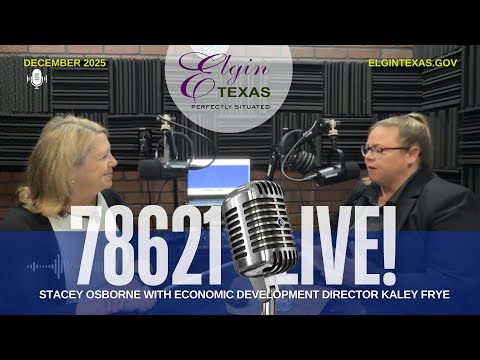
“Economic development is … attracting, supporting, and recruiting businesses to the community for the purposes of job creation and enhancing the local economy,” Frye said during a recorded interview on 78621 Live with Stacey Ford Osborne, acting public information officer for the city of Elgin. Frye noted the EDC is funded by a half-cent sales tax authorized under Texas law and the state constitution.
Frye described the EDC as a Type B corporation — the classification that allows funding for community enhancements, infrastructure and a range of commercial and retail projects rather than only primary-headquarter jobs. She said the Elgin EDC board has seven members (five business owners and two city council members) appointed by council.
On business support, Frye said the EDC offers citywide business enhancement grants, “which goes up to $25,000,” and provides data, demographic and permitting assistance intended to speed startups and small-business expansions. “We also have some pretty cool data and analytics tools and demographic tools that we use and we share with the community,” she said.
On incentives for larger projects, Frye said there is no one-size-fits-all package: the EDC may fund infrastructure (roads, utilities, fiber), offer land from the city business park, provide land reimbursements or use job-grant payments tied to hiring milestones. “No project ever looks the same,” she said, explaining that incentives are typically tied to investment commitments and job-creation benchmarks.
Frye said several projects already benefit from combined local, state and federal resources because of their expected economic impact, citing semiconductor-related funding in the region. She also described confidentiality around real-estate negotiations: companies often request non disclosure while talks proceed to avoid alerting competitors or employees, and deals generally come to council once a contract is ready for public action.
Highlighting Elgin’s location and quality of life, Frye said the city offers available, relatively affordable land near major regional employers and is within easy driving distance of regional infrastructure and an airport. She said downtown is nearly fully occupied and that city-run programming — parks, Main Street and the library — supports community livability.
Frye said the EDC has three businesses under construction in the business park and four to five pending negotiation deals that she described as potentially "game changing." She said a top priority for the coming year is business retention and expansion work that had been deprioritized when staff were short, and that the EDC will modernize marketing, including its website and social-media outreach.
For more information, Frye directed listeners to the EDC website and provided her city email, kaylee.fry@elgantexas.gov. The EDC also maintains LinkedIn, Facebook and Twitter pages.