Get Full Government Meeting Transcripts, Videos, & Alerts Forever!
Get email alerts on the Artificial Intelligence Mental Health topic
No spam. Unsubscribe anytime.
Board of Behavioral Sciences webinar spotlights AI’s promise and pitfalls for mental health practice
Summary
A Board of Behavioral Sciences webinar drew nearly 400 participants for a one-hour panel that balanced AI’s potential to reduce clinician paperwork and expand access with warnings about privacy, non–HIPAA-compliant tools, bias, deskilling and the need for clear policies and consent.
The Board of Behavioral Sciences convened a one-hour lunchtime listening session on artificial intelligence and mental health practice that gathered clinicians, technologists and hundreds of viewers to discuss the promise and risks of AI in behavioral health.
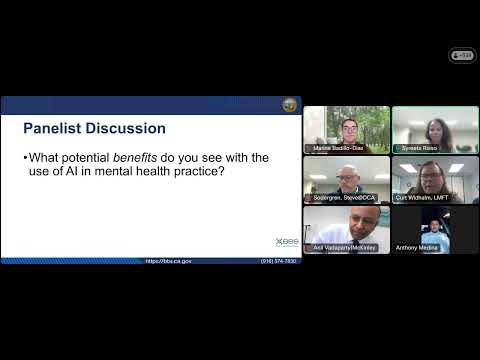
Sarita Rizzo, outreach coordinator and research analyst with the Board of Behavioral Sciences, opened the webinar and framed it as a listening session for licensees, registered associates, trainees and students. Four panelists offered practical examples and cautions. "I absolutely see the benefits of using AI in mental health practice," said Dr. Marina Badillo Diaz, LCSW, a clinical social worker and adjunct professor who said she has trained more than 4,500 social workers on integrating AI. She cited administrative uses such as AI scribes and tools to find community resources and described apps (named in the session) that can supplement care and flag crises to school-based teams.
Anil Vadapati, CEO of McKinley, a Southern California human services organization, described AI as a "clinical assistant" that can shorten time-consuming record review: he cited a project that used IBM's WatsonX to run comprehensive case-record reviews in minutes. "These are things that in the past would take our therapists hours and sometimes days to do," he said, adding that time saved can increase direct client engagement.
Panelists also emphasized access and equity gains, including chatbots for people who cannot afford traditional services and wearables that provide data between sessions. "Some tools are showing less racial bias in treatment," said Kurt Whidham, chair of the CAMFED Ethics Committee, noting potential benefits for people who do not fit standard diagnostic checkboxes.
But the panel balanced enthusiasm with multiple cautions. Dr. Badillo Diaz warned that many widely available, free AI tools are not HIPAA-compliant and urged clinicians to rely on healthcare-grade products for sensitive data. "We really want to ensure that clinicians are using these tools responsibly and ethically," she said. Panelists repeated concerns about privacy and data ownership, with one public commenter asking what happens to the highly personal information users share with corporate AI services.
Anil Vadapati and other panelists stressed limits to AI’s clinical role. "AI is a machine; machines by nature cannot show empathy," Vadapati said, warning that overreliance can be dangerous and that hallucinations and errors remain real problems. Panelists also raised risks of deskilling—clinicians losing practice in basic assessment and judgment if they overdepend on AI—and an accountability gap over who is liable if AI produces incorrect conclusions.
Public commenters amplified those worries. One commenter said AI development by corporations risks "giving up control" of client information and of professional work; another, identifying herself with California social work ethics leadership, urged that AI should not be allowed to make diagnoses and recounted cases where clinicians recorded sessions without disclosure to feed AI tools. A commenter referenced a figure—"somewhere between 30 and 40 percent"—for AI-generated errors in medical-record transcripts; panelists did not corroborate that number during the session.
On ethics and governance, panelists urged agency-level policies, informed-consent practices, ongoing AI literacy training for students and supervisees, and technical competency standards for clinicians. "Agencies should develop AI policy," Dr. Badillo Diaz said, including transparency on how AI is used and client consent. Panelists also called for broader standards and regulatory frameworks to align technical safeguards with clinical practice.
The webinar closed with panelists sharing resources (Dr. Badillo Diaz referenced aisocialworker.com and published experts), and the Board said the recorded session will be posted and viewers invited to complete a follow-up survey to inform future listening sessions. The Board did not propose immediate regulatory changes during the webinar; panelists and attendees repeatedly urged continued forums and the development of clear policies and standards as next steps.