
TACIR debate over deed‑fraud recommendations ends in procedural correction; report tabled until January
Get AI-powered insights, summaries, and transcripts
Subscribe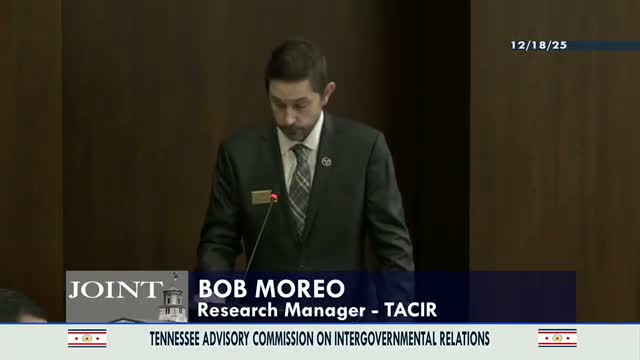
Summary
After weeks of staff work, TACIR presented a final report recommending an optional pilot allowing registers of deeds to require ID and a proposal to define deed‑theft offenses; strong testimony from registers of deeds and privacy concerns prompted debate and a procedural correction that left the report TABLED for reconsideration on Jan. 30.
The Tennessee Advisory Commission on Intergovernmental Relations on Thursday reviewed a final staff report on real‑estate fraud that recommends optional pilot authority for registers of deeds to request photo identification and, in some cases, employ third‑party identity proofing when documents are filed, and asks the General Assembly to define specific offenses for deed theft and related property fraud.
Research manager Bob Maurio told the commission the report retains three prior recommendations — stronger notary training, stricter notarization records and giving registers authority to review suspicious documents — and adds two new options modeled after programs in Arkansas, Florida and Texas: an optional pilot to request photo ID for grantors and a recommendation to create dedicated deed‑theft criminal offenses to simplify prosecution.
The report drew sharply divergent testimony. Willie Brooks, Shelby County register of deeds, urged action and described rising local impact: “In ’24 the estimated fraud amount was $4,500,000 with 33 cases; in ’25 we had 40 cases and an estimated $6,500,000,” Brooks said, arguing that walk‑in filings, not e‑filing, account for many frauds and that an optional pilot in Shelby County could help.
Several registers and association representatives supported stronger notary requirements and voluntary fraud‑alert systems but warned of costs, uneven county capacity and privacy risks from attaching identification to public records. One register cautioned that including drivers’‑license data in public files could hand fraudsters “a gift” by making personal information easier to harvest.
Commissioners pressed for clarity on implementation details — what type of ID, how long records would be retained, whether IDs would appear in publicly searchable records and how liability would be handled if a register refused to record a document. Maurio said the proposal would allow participating counties to store copies securely and to exempt attorneys or certain professionals; third‑party credential analysis would be optional for participating registers.
Representative Parkinson moved to approve the report; Representative Love seconded. A roll call returned 10 ayes and 7 nays and the chair initially announced the report approved. Executive Director Cliff Lippert later told the commission that approving a final report requires two‑thirds of members present and voting under the commission’s bylaws, meaning the tally did not meet the legal threshold. Members then voted to table the report and revisit it at the commission’s Jan. 30 meeting.
Next steps: staff will incorporate the additional research and the implementation questions raised by registers and legislators, and the commission will reconsider the report and any proposed language for pilot parameters in January. The report and the records of testimony will accompany the January briefing so legislators and stakeholders can review specific privacy, funding and liability options before any statutory proposal is drafted.