
Michigan House introduces multiple bills and reports enrolled measures to governor; chamber adjourns
Get AI-powered insights, summaries, and transcripts
Subscribe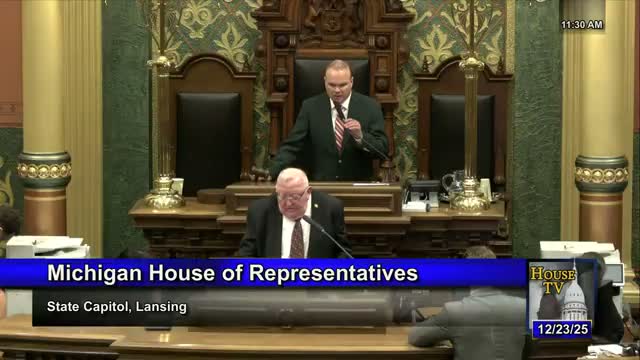
Summary
The Michigan House recorded the first reading of dozens of bills — including appropriations, public health, taxation and school-aid measures — announced enrolled bills sent to the governor with time stamps, received audit and university reports, and adjourned without day.
Lede: The Michigan House opened, the clerk reported the print and enrollment of several bills presented to the governor, and members introduced a broad slate of new House bills spanning appropriations, public health, taxation and education before the chamber adjourned without day.
Nut graf: Across the morning proceeding the clerk listed enrolled bills and exact presentation times to the governor and the House received a performance audit from the Auditor General and a two‑year progress report from Grand Valley State University about GEE Compass Academy. Representatives offered numerous bills that were read a first time and formally referred to standing committees; no floor debate or roll-call votes were recorded in the transcript.
Body: An unnamed presiding officer called the House to order. The clerk opened the board for attendance, directed members to check in at their desks and announced that a quorum was not present.
The clerk then announced a set of bills that had been reproduced and made available electronically on Thursday, Dec. 18, and read a list of enrolled bills presented to the governor on Monday, Dec. 22, providing time stamps for each (examples recorded in the transcript include Enrolled HB 4098 at 01:30 PM, HB 4099 at 01:32 PM, HB 4285 at 01:44 PM and HB 5078 at 01:56 PM). The clerk also stated receipt of a performance audit from the Auditor General on the Partnership Accountability, Training, Hope and Program Deferrals at the Michigan Department of Health and Human Services (Dec. 2025) and a progress report from Grand Valley State University on GEE Compass Academy’s first two years of operation.
A series of bill introductions followed. The transcript records Representatives offering bills that were read a first time by title and referred to committee; examples include: - HB 5424 (as transcribed) to amend the Michigan Vehicle Code, referred to Government Operations. - HB 5425 (as transcribed) to amend the Offenders Registration Act, referred to Judiciary. - HB 5426 (as transcribed) to amend the Code of Criminal Procedure, referred to Judiciary. - HB 5427 (as transcribed) to amend the Revised School Code, referred to Government Operations. - HB 5428 (as transcribed) to amend the State School Aid Act of 1979, referred to Government Operations. - HB 5429 (Representative McDonald) to make, supplement and consolidate appropriations for various state departments and branches for the fiscal year ending Sept. 30, 2026, referred to Appropriations. - HB 5430–5432 (as transcribed) including additional public health and appropriations measures, referred as noted to Natural Resources & Tourism and Appropriations. - HB 5433–5435 (as transcribed) addressing the Use Tax Act and Motor Carrier/Motor Fuel Tax Acts, referred to Transportation & Infrastructure. - HB 5436–5438 (Representative Devendorff) addressing the Insurance Code of 1956, an official personal identification card, and public health code changes, referred to Insurance and Judiciary committees. - HB 5439 (as transcribed) to establish a homeless advocacy fund in the Department of Treasury, referred to Government Operations. - HB 5440 (as transcribed) addressing the Income Tax Act of 1967, and HB 5441–5445 (Representative Andrews, Representative Van Drews and others as transcribed) covering marijuana licensing and regulation, referred to Regulatory Reform. - HB 5445–5447 (Representative Wozniak, Representative Thompson) covering revisions to the Judicature Act of 1961, public health code amendments and criminal procedure changes, referred to Judiciary and Health Policy where specified.
The transcript records that each bill was considered read a first time by title and referred to the committee named on the record; the transcript does not record subsequent debate, amendments, roll‑call votes, or final dispositions for these introduced bills.
At the close of the session the House stood at ease and received a message from the Senate delivered by Dan Oberlin, Secretary of the Senate, informing Speaker Matt Hall that the Senate had completed business and was ready to adjourn. The presiding officer declared the House adjourned without day at 12:00 noon under a concurrent resolution and constitutional provision specifying that hour.
Ending: The transcript records procedural steps — introductions, referrals and interchamber communication — but no recorded floor votes or committee actions. Follow‑up on the introduced bills will occur in the committees to which they were referred; the record of this session is limited to first readings, enrollments reported to the governor and the audit/university reports presented to the House.