
Education Department to launch new Section 117 portal Jan. 2, adds bulk upload and amendment tracking
Get AI-powered insights, summaries, and transcripts
Subscribe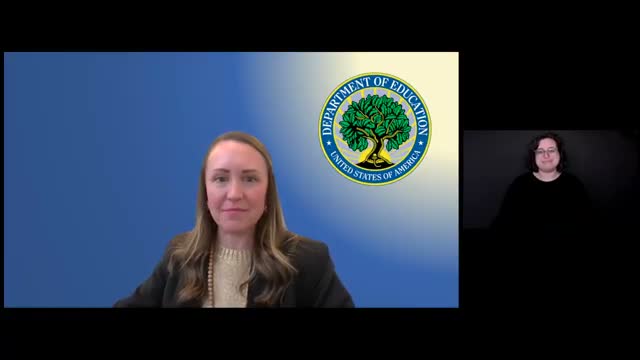
Summary
The U.S. Department of Education said it will launch a modernized Section 117 reporting portal on Jan. 2 to make disclosure of foreign gifts and contracts simpler; the new system adds bulk upload, role-based workflows, amendment tracking and public dashboards, with a Feb. 2 reporting deadline.
The U.S. Department of Education on a training webinar announced a redesigned online portal for Section 117 disclosures, saying the system will go live Jan. 2 and will include bulk upload capability, role-based review workflows and amendment tracking intended to simplify reporting of foreign gifts and contracts.
Undersecretary Nicholas Kent, who opened the webinar, said Section 117 of the Higher Education Act has required institutions to disclose gifts or contracts from foreign sources exceeding $250,000 since 1986 and described the portal as ‘‘a hedge against foreign influence on our campuses’’ designed to protect academic freedom and increase transparency to students and taxpayers.
The new portal, presenters said, is intended to cut duplicative data entry and give institutions a clearer record of submissions. Paul Moore, the department's deputy general counsel and chief investigative counsel, said compliance has improved since a basic portal launched in 2020 but described the goal as ‘‘100% compliance.’'
Speakers walked attendees through key features. The portal will require the institution's primary destination point administrator (PDPA) to sign in using login.gov, then assign roles such as analyst, sponsor (manager) and PDPA. Analysts enter data, sponsors review and submit, and the PDPA performs assignment functions.
For single-transaction reporting, users will answer an applicability check ("Does the transaction involve a foreign source?") and, if yes, must provide the foreign source's legal name (required; 300-character maximum), classification (government, legal entity, individual, agent), address and the transaction amount in U.S. dollars. The portal will prompt warnings for entries under $1,000 and for dates more than six months in the past to help ensure accurate analysis, presenters said.
To submit multiple disclosures at once, institutions will download an Excel template preconfigured with required headers and validation macros, populate it, and upload it as a bulk transaction file. Presenters warned that altering the template headers will prevent uploads from working.
The system includes a review workflow and an amendment timeline. Managers can see tabs for reports that are ready for review, rejected/pending amendment, or already submitted to the department; the amendment timeline shows field-by-field comparisons of previous and current values and stores manager/analyst comments to preserve an audit trail.
Gary Stevens, director of enterprise technology services, demonstrated executive dashboards that visualize totals by institution, country and transaction type and allow users to drill down to institution-level data. Demo data shown included long-standing reported amounts and a breakdown by country and transaction type.
Officials reiterated that the underlying legal standard for Section 117 reporting is unchanged. Paul Moore said the guidance and career staff remain the same and that technical questions about the portal should be directed to foreigngiftsaccess@ed.gov, while substantive policy questions should go to foreignsourcereporting@ed.gov.
Key dates provided on the webinar included immediate cutover of the existing portal access (described during the session as being cut off at 11:59 p.m. on the day of the webinar), distribution of webinar recordings and materials via Federal Student Aid's Knowledge Center on Dec. 18, the new portal launch on Jan. 2 and a filing deadline of Feb. 2 for required disclosures (moved to Feb. 2 when typical month-end deadlines fall on a weekend). The department said training materials, user guides and videos will be posted to support institutions during the transition.
The department named several universities that participated in beta testing and provided feedback used to refine features: University of Texas at Austin; MD Anderson; University of Texas Medical Branch; University of Southern California; Pepperdine University; Purdue University; Indiana University; Washington University; and the University of Arizona.
The webinar closed with a brief Q&A and a reminder that Section 117 policy itself is not changing; the portal is intended to modernize reporting and reduce administrative burden while maintaining the statutory disclosure obligations.