SB 254 requires WMPs to align with GRC cycles; utilities warn of forecasting, stakeholder and coordination challenges
Loading...
Summary
Energy Safety told utilities WMP submissions will be aligned with each utility's general rate case cycle and move to a four-year planning cadence; utilities raised concerns about long forecasting windows, suggested cumulative targets and bridge plans, and urged coordination with the CPUC.
Nicole Dunlap of the Office of Energy Infrastructure Safety introduced the WMP submission cadence change required by SB 254: WMPs must align with each electrical corporation's general rate case (GRC) or ramp filing cycles, the WMP cycle will extend to four years, and annual WMP updates will no longer be required.
"It puts each electrical corporation on their own WMP cycle as opposed to historically all WMPs have been submitted in the same year," Dunlap said when describing the regulatory change and its immediate implications for filing schedules and longer-term forecasting.
Utility speakers described practical challenges. Jay Landon of PG&E said under a strict reading of SB 254 his company would be required to file a four-year base WMP in 2028 that covers 2031 through 2034, meaning plans would be made up to seven years in advance. "So that's 1 way we do it," Landon said when explaining the timing challenge and suggested a cumulative target approach: "maybe go to a cumulative target across 4 years ... complete x amount by the end of 2034."
SDG&E and others recommended bridge plans or combined update/base filings in earlier years to avoid very long unchangeable forecasting windows. Several participants urged Energy Safety to define an approval pathway for mid-cycle updates, explaining that events such as permitting delays, regulatory orders (EUPs), or new climate assessment data will necessitate changes and that clarity is needed about whether Energy Safety or the CPUC will approve changes.
Stakeholders raised concerns about stakeholder engagement when each utility has its own staggered WMP timeline. "This poses a lot of challenges for folks, stakeholders on the outside ... trying to identify best practices," said Will Dunning of Energy Safety, urging OEIS to consider mechanisms to preserve cross-utility sharing and public participation.
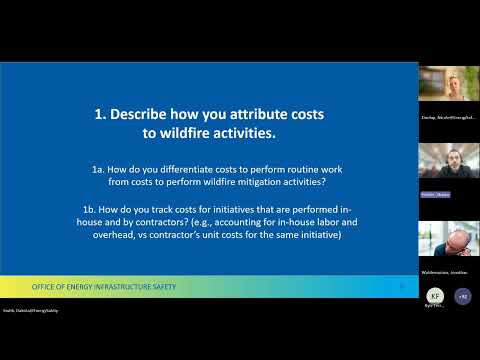
Miles Gordon of the California Public Advocates Office urged standardization between WMP initiatives and GRC cost categories so analysts can trace costs between filings: "I would really like to see some kind of standardization of scope and nomenclature between WMP initiatives and GRC cost categories," he said.
Utilities offered several practical mitigation ideas: cumulative four-year targets rather than detailed year-by-year mandates, explicit "bridge" WMPs to cover calendar gaps, and an avenue for reporting progress outside of formal WMP updates. Energy Safety closed by asking for written comments to its WMP guidelines docket by Monday, January 19, and said it would post slides and the recording to the docket and YouTube.
The agency will use the feedback to develop revised WMP guidance implementing SB 254 and said it is open to suggestions for future workshops and coordination with the CPUC to address cross-agency approval and reporting issues.