Lifetime Citizen Portal Access — AI Briefings, Alerts & Unlimited Follows
Regulators, utilities debate how to measure 'cost per avoided ignition' under SB 254
Loading...
Summary
At an Office of Energy Infrastructure Safety workshop, utilities described using budget codes, condition codes and asset-level modeling to track wildfire mitigation costs and estimate avoided ignitions; regulators sought input on proxies, counterfactuals and data gaps.
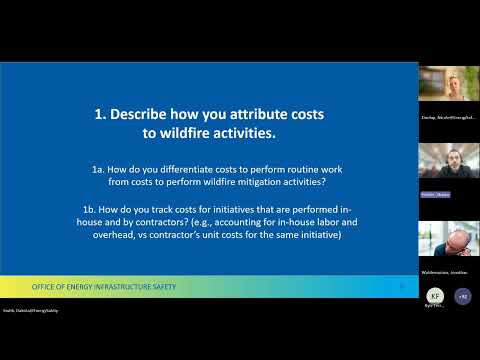
Nicole Dunlap, a program manager at the Office of Energy Infrastructure Safety, opened the workshop by citing a new SB 254 requirement that wildfire mitigation plans include "an estimate cost per avoided ignition for each risk or an explanation on why such a value cannot be assigned" and asked utilities to explain their accounting and modeling approaches.
Utility representatives said they separate wildfire-mitigation spending from routine work through accounting tags and targeted condition codes. "We have a, what we call a budget code that we assign to that initiative or that program, and also an internal order number," Jonathan Waldemar of SDG&E said, describing the company's SAP-based tracking system for distinguishing wildfire programs from routine operations and contractor versus in-house costs.
PG&E and SoCal Edison representatives described similar approaches. PG&E's Sean Holder said fields in SAP allow the company "to pull reports off that, for the WMP and other reporting purposes." SoCal Edison's Brian Landry noted the practical limits of averaging across heterogeneous terrain: "There's an averaging bias and uncertainty in both the numerator and in the denominator," he said when discussing cost-per-mile averages used in undergrounding cost-efficiency calculations.
Workshop participants pressed utilities on several technical points that matter for calculating a cost per avoided ignition. Questions focused on (1) whether utilities attribute partial credit to multi-purpose activities or instead tag whole activities as mitigation; (2) how granular cost and risk measures are (asset/span, feeder segment, circuit); and (3) whether proxies such as outages or wire-down events can reasonably be converted into avoided-ignition estimates.
SDG&E explained its models combine a probability-of-failure model with a conditional probability-of-ignition model, calibrated to historical outages and weather, then roll up span-level calculations to feeder segments and monetize risk reduction through an expected-value approach. "Our probability of failure model, our conditional probability of ignition that together, they tell us how many kind of the amount of ignitions per year," Joaquin (SDG&E representative) said.
Panelists acknowledged limitations. Several speakers warned that not all ignitions are equivalent: weather conditions, ignition location and downstream consequences vary, so converting proxies into a single "avoided-ignition" number can be misleading without careful normalization and scenario-based modeling. Brian Landry said modeling uses many weather scenarios and stochastic years to capture that variability, and added that mitigation effectiveness is often driver- and location-specific.
Audience members argued for capturing "near misses" and field-discovered condition issues as a source of learning and potential counterfactual data. "If somebody climbed up a pole and found a C-hook that was 99% rusted through and they replaced it, that's an avoided ignition of sorts," said Will Dunning of Energy Safety; utilities replied such discoveries are useful for controls and condition assessment but converting each near-miss into a quantified avoided ignition is complex and often context-specific.
The workshop did not produce a single method for converting mitigation spending into a standardized cost-per-avoided-ignition figure, but it surfaced common practices (budget/condition codes, asset-level modeling, stochastic fire-weather scenarios), limitations (low sample sizes for actual ignitions, heterogeneity of consequences), and potential next steps: define acceptable proxies, require documentation of accounting tags and model assumptions, and create guidance on when a mitigation's benefits can be treated as location-specific versus system-wide.
Energy Safety asked for written comments to its docket by Monday, January 19, and said the discussion would inform revised WMP guidelines that must implement SB 254.
The workshop will inform Energy Safety's WMP guideline revisions; utilities and stakeholders were encouraged to submit written comments and suggested next steps including standardizing how near-miss and proxy data are reported and harmonizing modeling assumptions across utilities.