
South Pasadena tutorial: how the city’s new three‑stream waste system works under SB 1383
Get AI-powered insights, summaries, and transcripts
Subscribe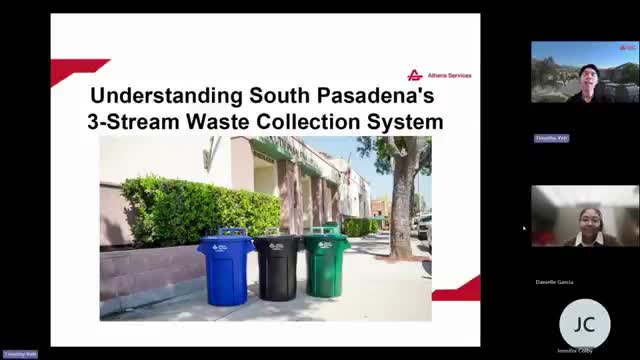
Summary
City staff and Athens Services released a 25–30 minute tutorial explaining the transition from a two‑stream to a three‑stream waste collection system required under California’s SB 1383, detailing what goes in recycling, organics and trash bins, deployment timing, resources and enforcement steps.
Timothy, a government affairs manager at Athens Services, and Danielle, City of South Pasadena staff, presented a roughly 25–30 minute informational tutorial explaining the city’s transition from a two‑stream to a three‑stream waste collection system required by state law.
The change separates trash, recycling and organics into distinct containers so the city can meet state requirements aimed at cutting methane from landfills and recovering food for distribution. "This is a state mandate from the state of California," Timothy said, explaining the rationale behind the rollout and its focus on reducing landfill organics.
Why it matters: The new system requires households, multifamily buildings and businesses to sort materials into three containers and gives residents guidance and options to avoid contamination. City staff and Athens outlined container sizes, what commonly accepted materials are, and where to take hazardous items such as medication and electronic waste.
Key facts and rollout timing: Athens added a blue 96‑gallon recycling cart and a green 64‑gallon organics cart for bin customers; manual barrel service customers received Athens‑labeled 32‑gallon barrels and are eligible for up to seven barrels (a minimum of one black, one blue and one green). Timothy said the first deployment round ran from mid‑November into early December and that Athens expects to complete adjustments and a second round by January 2026. Residents with bin service were told their carts arrived in late August or early September.
What goes where — headline rules: - Recycling (blue): glass, aluminum and most paper products — items should be "empty and dry." Plastic resin codes 1, 2 and 5 are commonly accepted; mixed packaging, plastic bags and heavily food‑soiled items can contaminate loads and should go to trash. - Organics (green): food scraps and yard waste, including meats, bones, dairy and eggshells accepted by the Athens composting process. Fiber‑based food‑soiled paper that passes a grease or "shine" test is acceptable. Timothy noted Athens processes organics to a level that allows compost giveaways to residents twice a year. - Landfill/trash (black): items that do not belong in recycling or organics — examples given include potato chip bags, Capri Sun pouches, cigarette butts, ketchup packets, pet waste and diapers.
Hazardous materials and special disposal: Residents were directed to Med Take Back California for unwanted medication and to sharps takeback programs for needles; Athens and city materials list a nearest e‑waste drop‑off in East Los Angeles that operates weekends 9 a.m.–3 p.m. and points residents to LA County e‑waste event listings.
Tools, in‑person help and enforcement: Athens’ interactive "What Goes Where" guide and the City of South Pasadena’s Environmental Services and Sustainability pages were cited as resources. Danielle walked viewers through the website path and noted City Hall at 1414 Mission Street and a public works representative at the front desk for in‑person help. Athens will monitor contamination and issue courtesy pickup tags explaining the problem; continued contamination may result in a contamination fee added to a customer’s bill.
Contact and logistics: Athens customer service number provided: (888) 336‑6100 for repairs, replacements and barrel or cart orders. Athens will collect and recycle old barrels through January 2026 (extended from December). Residents who missed container selection deadlines can still request sizes through Athens customer service; a $40 delivery fee may apply for late changes.
Next steps/closing: City staff and Athens asked residents to use the posted online resources and contact city staff or Athens if they need help arranging containers or understanding what goes in each cart. "We appreciate your time and your opportunity to learn more about what goes where," Danielle said as the tutorial closed.