
Oversight commission urges sheriff to restore co‑response teams and revisit non‑response policy for some mental‑health 911 calls
Get AI-powered insights, summaries, and transcripts
Subscribe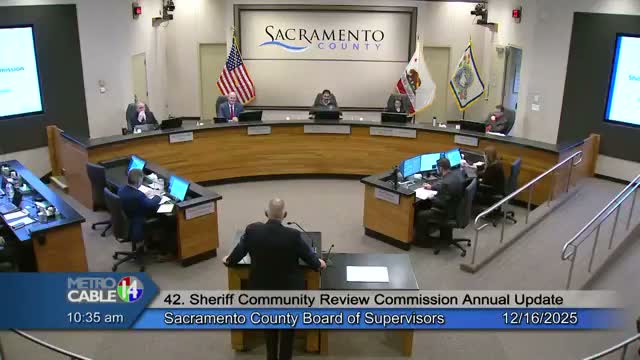
Summary
The Sheriff Community Review Commission presented an annual report urging improved coordination after a policy change limiting sheriff responses to certain mental‑health calls; the commission recommended restoring co‑response crisis teams, fixing 911/988 interoperability gaps, and providing regular data; the board asked staff to draft a resolution encouraging sheriff participation in the commission.
The Sheriff Community Review Commission presented its annual report to the Sacramento County Board of Supervisors Dec. 16, with the commission urging changes after a sheriff policy reduced sheriff responses to some calls with a mental‑health component.
Paul Curtis, chair of the commission, told the board that an ad hoc committee studied the policy change and produced seven unanimous recommendations. The recommendations call for better external engagement before policy changes, improved interoperability between 911 and 988, restoration of co‑response crisis teams that pair deputies with behavioral‑health clinicians, and regular data reporting so the commission can monitor impacts. Curtis emphasized one recommendation he described as the commission’s most important: asking the sheriff’s office to respond when callers report active self‑harm and the presence of a weapon, because the commission concluded it is unacceptable for no one to respond when a person is at imminent risk.
Curtis and other commissioners highlighted an example earlier this fall in which they said an individual died after no one responded; the commission said that experience informed its push for restored co‑response capabilities. Commissioners also noted that when the sheriff preemptively implemented the policy change there was limited notice and insufficient coordination with partner agencies, and that some gaps have since been addressed—such as interoperability improvements between 911 and 988—but others remain.
Board members pressed county counsel and staff about options to increase sheriff office participation at commission meetings. County counsel cautioned that the sheriff is an independent elected official and cannot be compelled to attend, but the board directed staff to draft a non‑punitive resolution to underscore the importance of the sheriff’s participation at commission meetings; staff committed to bring a draft by January.
Members of the board and commission discussed mutual‑aid alternatives but said neighboring agencies and the California Highway Patrol are reluctant to assume that work on an ongoing basis because of jurisdictional and liability concerns. Several supervisors and commission members argued that restoring the crisis response teams that paired a deputy with a clinician produced better outcomes and should be a priority for reimplementation.
The presentation also covered other ad hoc reviews—halal meals in county jails (commission says halal meat is now served once daily and the written policy is pending), military equipment reporting compliance, and a review of the Blue Envelope program for disability‑friendly identification—and concluded as an informational report with no formal board action.