Get Full Government Meeting Transcripts, Videos, & Alerts Forever!
Get email alerts on the Parks Impact Fee topic
No spam. Unsubscribe anytime.
Oceanside Council Adopts New Parks Impact Fee Schedule, Drops ‘Mansion’ Cap After Heated Debate
Summary
After hours of public comment and council questioning, Oceanside’s City Council adopted a revised parks impact fee structure on a 3–2 vote, moving from per‑unit fees to per‑square‑foot charges (to comply with state law) and removing a maximum cap on large single‑family homes.
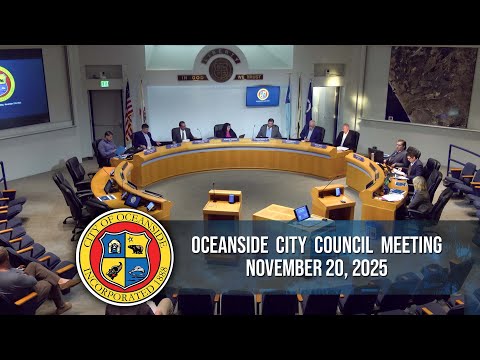
Oceanside’s City Council narrowly adopted a new parks impact fee schedule on Nov. 19, 2025, switching from a per‑unit charge to a per‑square‑foot fee and approving amendments that eliminate a cap on very large single‑family homes and set a minimum fee per unit. Deputy Mayor Joyce, who led the motion, said the changes ensure new development pays what the nexus study calculates as its fair share.
The city’s revised nexus study — prepared by Economic & Planning Systems and peer‑reviewed by Harrison Associates — calculates a per‑resident parks cost of about $4,100. That number was converted to a per‑square‑foot fee, producing proposed rates of roughly $4.18/sq ft (single‑family) and $6.79/sq ft (multifamily) in the first phase, stepping up to about $6.03/sq ft and $9.24/sq ft respectively in later adjustments. Staff estimated maximum potential revenue from the fee (if charged at the maximum rates) at about $47 million between now and 2035; the parks capital improvement plan totals about $220 million.
Supporters at the public hearing urged immediate full implementation. Diane Nygaard of Preserve Calavera said the fee would “touch the lives of everyone who lives, works, or plays here” and argued for prompt adoption. Joan Bachman, a former planning commissioner, urged the council to take the maximum allowed now, noting fees hadn’t been updated in decades.
Opponents and skeptical speakers said one‑time impact fees don’t pay for long‑term maintenance or fix existing funding shortfalls. GT Wharton, cofounder of Strong Towns Oceanside, said the fee “will work in the short term, but no, it will not work in the long term,” warning new fees can be passed through to buyers or renters. Council members also pressed staff on how micro‑units and ADUs would be treated; staff said ADUs under 750 sq ft are excluded by state law, and the council added a minimum per‑unit fee (about $4,105) so very small units don’t pay less than the per‑person cost.
Deputy Mayor Joyce said she moved three amendments: remove the single‑family maximum (the so‑called “mansion” cap), eliminate the staggered two‑year phase‑in so implementation happens as soon as state timelines allow, and set the minimum fee per unit to reflect the per‑person cost in the study. City Attorney Burke reminded the council that state law requires a 60‑day implementation tail and that the ordinance cannot be made effective sooner than that statutory minimum.
The resolution adopting the nexus study and fee schedule passed on a 3–2 vote (Joyce, Figueroa and Sanchez in favor; Robinson and Weiss opposed). Council members who voted no said they supported fee updates generally but opposed removing the maximum fee cap.
What’s next: the fee schedule can be amended via the annual Capital Improvement Program process, and the resolution sets an automatic annual adjustment tied to construction cost indices. Staff and council also discussed potential complementary funding strategies — grants, general fund allocations and leveraging future development revenues — to address remaining CIP shortfalls.