
Portsmouth council approves compressed police pay scale to help retain officers
Get AI-powered insights, summaries, and transcripts
Subscribe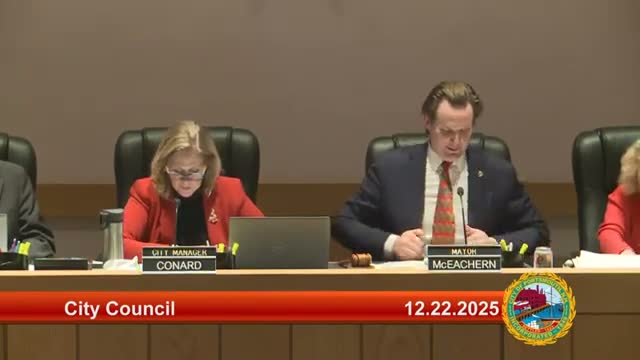
Summary
The Portsmouth City Council approved a memorandum of agreement compressing the police patrol pay scale from 18 steps to seven to make lateral hires more competitive and reduce overtime strain; council voted unanimously after staff and public comments about costs and charter procedure.
The Portsmouth City Council on Dec. 22 approved a memorandum of agreement with the Portsmouth Police Patrolmen’s Union that compresses the department’s existing 18-step pay scale into seven steps, shifting larger increases to the early years of service to make lateral hires and junior officers’ pay more competitive.
Deputy City Manager Carl Weber told the council the change is aimed at reducing costly turnover and mandatory overtime. “We surveyed surrounding departments,” Weber said, “and they’ve adopted a similar strategy. The market around us is changing significantly for police officers, and the city was particularly vulnerable when it came to junior officers.”
Police Chief Mark Newport said the department’s staffing had hit critical levels earlier in the year and that retention pressures have increased. “In November, Portsmouth was down to 61 officers,” Newport said. “As of today, we stand at 63 officers. This is still five less than were funded in the fiscal year 26 budget.” Newport and Weber highlighted an estimate that hiring, training and outfitting a new officer costs roughly $141,000 — a primary justification for investing in retention.
Staff materials provided to the council included an annualized projected cost of about $433,000 and a six‑month remainder cost of $216,732.86; staff said the change would be funded through existing budget vacancies and contingency set aside for collective bargaining rather than a supplemental appropriation. Deputy city manager and finance director Nathan Money was identified in the presentation as the staff contact to discuss the budget details further.
During public comment, resident Pietra Huda urged the council to follow charter appropriation procedures and cited a different FY26 cost figure that she read from materials as $2,216,007.32, saying the request would not comply with Charter section 7.14 unless the council followed appropriation and hearing rules. Councilors and staff responded that the proposed action represented a reallocation of authorized funds and that, in their view, a supplemental appropriation and public hearing were not required for the change as framed.
Councilor Taber moved to approve the MOA; the motion was seconded and passed on a roll-call vote with all voting members recorded as yes. The council directed staff to continue monitoring impacts and to report back as appropriate.
The approval is intended as an interim step ahead of full contract negotiations expected later; councilors stressed the change is designed to address immediate retention needs while longer-term bargaining continues.