
Elections office has built reserves; staff warn ranked‑choice voting adds major vendor costs
Get AI-powered insights, summaries, and transcripts
Subscribe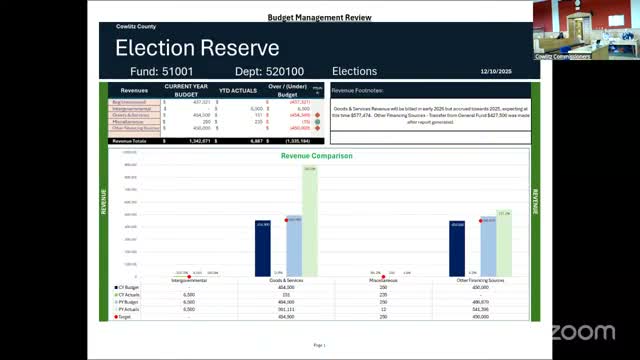
Summary
Finance and elections staff said elections funds include an operating fund and a capital reserve (15% of charges) built for equipment replacement. Staff warned that implementing ranked‑choice voting (RCV) would require significant vendor software costs — King County paid about $1 million for a vendor change — and urged time, funding, and voter education for legislative changes.
Kathy Funk Baxter and elections staff reviewed two elections funds the county maintains: an operating account for routine expenses and a capital reserve that receives approximately 15% of billings to build a replacement pool for equipment and tabulation systems.
An elections representative said the office captures full-year payrolls in a "thirteenth month" close-out process, bills jurisdictions based on incurred expenses, and then allocates maintenance costs between county and participating jurisdictions. "Typically... we would rely on a tabulation system for no longer than 10 years," the representative said, and the current balance reflects a longer replacement cycle than assumed. The representative noted the reserve exists to allow the office to "pivot" when new software or hardware is needed.
On policy change, staff warned that ranked‑choice voting (RCV) would create significant implementation costs for tabulation vendors. They cited King County’s experience, where the vendor added RCV capability at a price on the order of $1 million. The elections presenter said counties must be given time and sufficient implementation funding to educate voters and update systems.
The presentation also noted that supply costs can be high: Baxter said $72,000 posted in the account this year represented two ballot scanners. Commissioners asked whether billings cover elections’ costs; staff confirmed billings are tied to incurred expenses.