
Raymore approves Chapter 100 incentives for 'Iconic' Timber Trails multifamily and retail phases amid debate over tax abatements, 5-2
Get AI-powered insights, summaries, and transcripts
Subscribe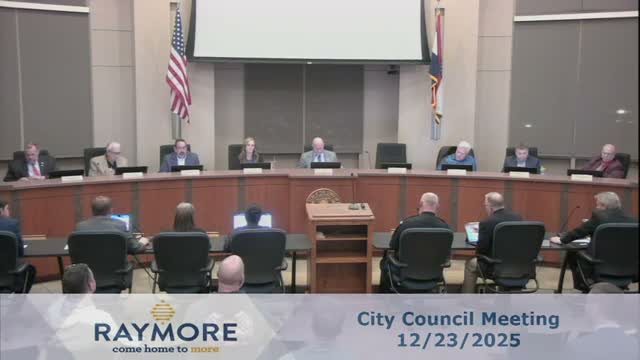
Summary
Council approved two Chapter 100 bond measures for the Timber Trails / Iconic development — a $56.6 million bond for ~300 apartments and a $3.675 million bond for retail — after debate over pilot structure, precedent for retail abatements and net tax impact; both measures passed 5-2.
The Raymore City Council voted in two separate first-reading actions Dec. 22 to authorize Chapter 100 industrial development revenue bonds tied to the Timber Trails development, now marketed as Iconic. The votes were 5–2 for the multifamily phase and 5–2 for the retail phase.
Staff and outside counsel explained that the Chapter 100 bond approvals implement the tax-abatement schedule the council approved with the development plan in 2023. For the multifamily (residential) phase the bond amount presented was $56,625,000 for approximately 300 Class A apartment units on about 17 acres at the northwest corner of Dean and Johnston. Under the documents before council, the abatement would begin no later than 2028 and extend for up to 25 years; the pilot is calculated as a dollars-per-unit payment starting at $14.48 per unit with a biannual escalation factor consistent with the previously negotiated performance agreement.
“The bonds would be for 56,625,000,” counsel stated during the staff briefing. City staff and bond counsel described the mechanics: the city issues the Chapter 100 bonds; the special-purpose entity pays a payment-in-lieu-of-taxes (PILOT) based on the agreed formula; construction materials may be exempt from sales tax under the Chapter 100 structure; and the pilot values are tied to the assessor’s valuation and the plan’s escalation assumptions.
Council debate focused on transparency of the pilot, the expected net-tax impact to local taxing districts, and the policy precedent created by using Chapter 100 for smaller retail components. Councilmember Baker and others pressed staff on estimates of net tax loss; staff said the detailed cost-benefit analysis and the projection method were part of the 2023 plan materials and that the pilot schedule was designed to mirror expected valuation increases (the plan uses a 1.5% increase every two years for projections).
For the retail/mixed-use phase (Bill 3993), staff described a roughly 13,560-square-foot multi-tenant retail building and a $3,675,000 bond amount. The standard abatement is 25% for the retail piece, with the opportunity to raise the abatement to 35% or 50% for individual years if leasing benchmarks are met (50% of leasable space leased by tenants generating at least $300 per square foot in taxable sales per month yields 35%; 75% of leasable space meeting that threshold yields 50% for that year).
Developer representative Matt Tapp (Griffin Riley Property Group) told council that retail will follow residential occupancy: “Retail follows rooftops, not the other way around,” he said, describing leasing and hotel interest tied to apartments coming online. Opponents on council warned that approving retail under Chapter 100 could set a precedent for smaller strip centers to pursue similar abatements.
Council approved both items on first reading (multifamily and retail) by 5–2 votes. Movers and seconders were recorded in the meeting minutes. Staff noted guarantees and performance agreement clauses are in place and that each bond issuance will operate under a separate special-purpose entity as reflected in the legal documents.