
Green Bay committee delays recommendation on new fire station in Fire Station Flats project
Get AI-powered insights, summaries, and transcripts
Subscribe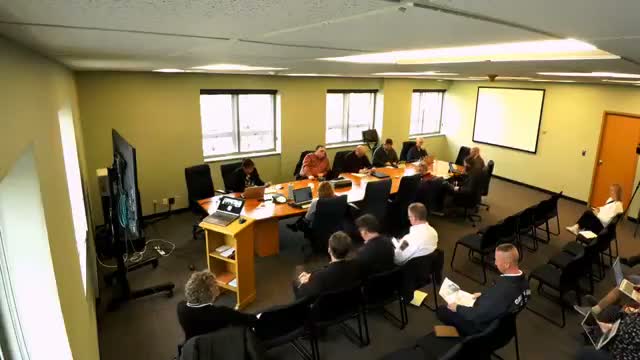
Summary
Developers and fire department presented schematic designs and three funding scenarios for a proposed 36,000‑sq‑ft fire station at 420 South Broadway; after questions about costs, funding (including $1M ARPA and city borrowing) and alternatives, the Ad Hoc Facilities Committee voted to hold a recommendation until January for further financial analysis.
Developers and the Green Bay Fire Department presented updated schematic designs and three cost scenarios on Dec. 18 for a proposed fire station to be built as part of the Fire Station Flats development at 420 South Broadway.
The development team described a three‑story station of roughly 36,000 square feet, with apparatus bays and decontamination on the first floor, living quarters on the second floor, and administrative/training space on the third. “We are proposing building a 3 story fire station project. It’s about 36,000 square feet at this time,” said architect Laura Eisendel during the presentation. The team said schematic design should be complete in January and that they are targeting a July bid and an August 2026 groundbreaking, subject to final approvals and financing.
The committee heard three budget scenarios the team described as apples‑to‑apples comparisons using a hard‑cost basis near $400 per square foot. The developer presented a full build estimate of approximately $19.5 million, a reduced option that shells the third floor (lower near‑term cost but higher future fit‑out expense), and a two‑story alternative that the team estimated at about $13.8 million. The developer noted those figures are preliminary and have not yet been fully vetted by market bids.
City finance staff outlined the likely local share and tax impact. The city has about $15 million in its capital improvement plan allocated to the project and previously authorized a $5.1 million commitment under the development agreement. Staff said $7 million in borrowing is programmed for 2026 and that $1 million in ARPA funds has been identified for project expenses. As a rough example using present interest‑rate assumptions, finance staff said, “for a $19,000,000 [borrowing] over the next…21 years, it would probably be a cost of about $1,400,000 a year to pay for the debt service of this fire station,” and that the per‑household impact depends on home value and final debt sizing.
Aldermen probed tradeoffs between building the third floor now versus deferring fit‑out or leasing administrative space elsewhere. Several members urged the committee to weigh the 50‑year life of the facility, operational efficiencies of colocated administration and station operations, and the taxpayer burden of higher near‑term borrowing. One alderman noted potential site‑level ways to reduce the city levy impact, including whether infrastructure costs could be paid from a Tax Increment District (TID) increment; city staff responded that TID funds may be used for infrastructure within the district but cannot be used to pay for a public facility building itself.
Committee members also asked for more precise numbers on FF&E and networking allowances (the developer said the packet contained older FF&E figures and that their update saved roughly $200,000), contingencies, and whether the project can be re‑phased or bid to hold a third‑floor shell as an add‑alternate. The developer said bidding in July will produce more accurate cost signals and that the team planned staged procurement and contingencies to reduce surprise exposure.
After extended discussion about funding sources, site alternatives (including a narrow site rotation tied to DOT planning on Broadway), and long‑term operational needs, the committee voted to hold action and return in January with additional analysis. The motion to hold the recommendation until a January meeting was made by Alder Galvin and seconded by Mary Henrich; the motion passed by voice vote.
What’s next: staff agreed to provide a follow‑up packet in January with analysis of TID‑eligible site expenditures, more detailed debt‑service scenarios, any offsets from returning Stations 1 and 3 to the tax rolls, and updated bid‑era estimates. The project team reiterated that delays could affect the target July bid timeline.
Votes at a glance: the committee unanimously approved the meeting agenda and minutes earlier in the session; the substantive committee motion on the fire station was to hold the item for further financial review and it passed on a voice vote (mover: Alder Galvin; second: Mary Henrich).