UDOT outlines Big Cottonwood Canyon winter transit plan: mobility hub, tolling and bus‑priority lanes proposed
Loading...
Summary
UDOT presented an Environmental Assessment proposing a mobility hub at a gravel‑pit site, enhanced bus service with bus‑priority lanes, enclosed resort bus stops at Solitude and Brighton, and electronic variable tolling to reduce winter peak congestion; UDOT seeks public comment through Jan. 19, and the U.S. Forest Service’s cooperating‑agency comment period ends Jan. 9.
The Utah Department of Transportation laid out its Big Cottonwood Canyon Winter Transit Environmental Assessment and the Proposed Action to reduce winter peak congestion on SR‑190 by combining enhanced transit, roadway changes and pricing. At a virtual public hearing, project staff described a multi‑element plan centered on a mobility hub at a former gravel pit, bus‑priority lanes through the Brighton Loop, and enclosed resort bus stops at Solitude and Brighton.
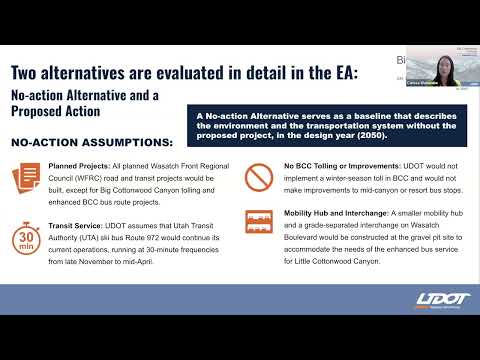
Project managers said the EA evaluates two alternatives — No Action and the Proposed Action — with the Proposed Action intended to lower peak travel times and maintain roadway capacity. “AM peak travel times are gonna be reduced by 27 to 31 minutes,” said Amy Croft, the presenter for purpose and need, citing model outputs that show No Action AM travel times near 56 minutes versus Proposed Action travel times of approximately 24 minutes for buses and 29 minutes for private vehicles in 2050.
UDOT described operational features intended to keep buses out of congestion: dedicated inside‑running bus lanes near the top of SR‑190, bus pullouts and raised passenger platforms at mid‑canyon stops (Cardiff Fork, Spruces Campground, Silver Fork, Silver Lake), and a bus‑activated signal and transitway paralleling Wasatch Boulevard to allow buses to bypass the Fort Union intersection. Adam Shaw noted the Forest Service would decide whether to authorize special use permits for resort transit stops and whether a forest plan amendment is needed at the Solitude parcel.
Tolling would be variable‑price and electronic, beginning just below Solitude Entry 1, designed principally to preserve an operational capacity target of about 1,000 vehicles per hour during peak winter periods. The project team said exemptions were likely for residents and employees in the toll zone and emphasized the toll collection would be electronic rather than a booth: “It would register you've driven through and send you a bill in the mail,” the team said.
The mobility hub concept includes a multi‑level parking structure sized to serve both Big and Little Cottonwood Canyons, bus storage to reduce deadhead travel, light maintenance bays and an on‑site transitway connection to Wasatch Boulevard. UDOT presented an estimated project cost for the Big Cottonwood EA of about $144,000,000 after accounting for previously counted items from the Little Cottonwood EIS; the presentation included a separate line item of roughly $18,000,000 for 30 buses and the bus‑priority lane features.
Environmental impacts and mitigation were described at a high level: the Proposed Action would convert roughly 34.5 acres (most at the gravel pit) compared with ~23 acres under No Action, with about a half‑acre of aquatic impacts noted in the EA and no impacts to federally listed threatened or endangered species reported in the presentation. The team said mitigation measures and detailed resource analyses are available in the EA on the project website.
Public comment is open through UDOT’s portal and has been extended to January 19; Cooperating‑agency (Forest Service) comments must be submitted by January 9 to be considered for the Forest Service’s decision process. UDOT staff said all substantive comments will receive a written response in the final environmental documentation.
The EA and architectural materials, including alternative concepts for Solitude and Brighton stops and renderings of the mobility hub, were posted to the project website for review. The agency said operational details — for example how mid‑canyon parking and potential misuse of bus stops to avoid tolls would be handled — are to be determined through later operational planning.