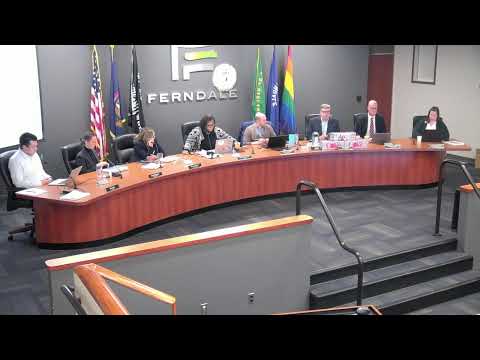
Ferndale council conditionally approves Axon ALPR contract, orders ordinance and audits

Ferndale City Council · December 16, 2025

Loading...

AI-Generated Content: All content on this page was generated by AI to highlight key points from the meeting. For complete details and context, we recommend watching the full video. so we can fix them.

Summary

Council voted 4–1 to approve a five‑year, $110,968 Axon automated license plate reader (ALPR) agreement, contingent on the adoption of a surveillance ordinance and companion policy to codify prohibitions, quarterly audits and a racial‑impact assessment; the funding source is drug forfeiture funds.

Ferndale City Council voted 4–1 to approve a five‑year, $110,967.60 agreement with Axon for automated license plate reader (ALPR) cameras, but the approval is contingent on the city adopting a new surveillance ordinance and companion policy before the first council meeting in February.

Police and city staff recommended a reduced ALPR footprint of nine fixed‑position cameras focused on major thoroughfares (9 Mile, 8 Mile and Woodward), with equipment, installation, maintenance and technology refresh included in the proposed contract. Police Chief Emmy told the council the technology "generates leads" and "has helped us close cases that would have gone unsolved," while stressing the department’s willingness to accept strict oversight measures. An Axon representative said the company agreed to multiple addenda clarifying data ownership and use.

Mayor Pro Tem Mikulski and other council members pushed for stronger, enforceable safeguards. The council’s stated conditions include codified prohibitions on vendor use of city data for product development or machine‑learning, explicit bans on facial recognition and live monitoring, mandatory quarterly usage and system audits with CPARB participation, public notice of camera locations within 10 days of deployment, and an annual racial‑impact assessment. Staff said ALPR data would be retained for a maximum of 30 days per the city surveillance ordinance unless moved to evidence.

Council members debated timing and transparency. Several residents who addressed the council in a lengthy public‑comment period urged delaying any contract, citing concerns that federal agencies could obtain data, and questioned the technology’s efficacy and vendor trustworthiness. Supporters in the audience and some council members cited past cases where license‑plate data aided investigations.

Council member Donnie Johnson moved the contract approval with the contingency; the roll call vote was Johnson (Yes), Mikulski (Yes), Kelly (No), Polica (Yes), Leaksmae (Yes). City staff and legal counsel said the contingency would require the city to issue a notice of termination if the ordinance and companion policy are not adopted by the contingency date. The council directed staff to involve CPARB in quarterly audits and to present the ordinance for two readings with a public hearing as part of the ordinance process.

The police recommended funding the program from drug‑forfeiture funds; staff reported available balances sufficient to cover the agreement so as not to use general fund dollars. Officials estimated a minimum installation window of roughly 4–5 months if the council finalizes the contract.

Next steps: staff will finalize contract paperwork and proceed with permitting and drafting the ordinance and companion policy, and council will hold public hearings as required by the ordinance process.