
Mt. Healthy board hears two levy options to address fiscal emergency
Get AI-powered insights, summaries, and transcripts
Subscribe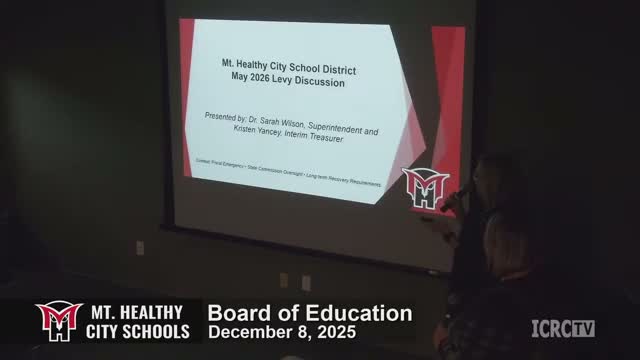
Summary
Board heard a detailed presentation on May 2026 ballot options to address a district fiscal emergency: a continuing 5.95‑mill property levy (estimated $3.17 million/year) or a 0.75% earned income tax (estimated $3.30 million/year). A special meeting is scheduled to vote on the levy type.
The Mt. Healthy City Schools board on Dec. 8 heard a presentation laying out two options the district could place on the May 2026 ballot to address an ongoing fiscal emergency: a continuing 5.95‑mill operating property levy or a 0.75% earned income tax.
The district presenter told the board the district "is, of course, in a fiscal emergency currently, and we do operate currently with a state appointed financial planning and supervision commission," and warned that the district must demonstrate several years without deficit spending to be released from that oversight. The presenter also flagged solvency assistance loan payments that rise from $750,000 this year to $1.2 million next year and $1.6 million thereafter.
Why it matters: the board has been under state fiscal supervision and is operating with a pay freeze; trustees said restoring revenue is needed to avoid further program and staffing cuts. The presenter said the district has not had an operating levy since 2003 and that inflation and legislative changes have eroded effective millage.
What the options would do: the continuing property levy (scenario 1) is estimated to bring about $3,167,953 annually; presenters and staff said the levy is familiar to voters but would affect homeowners and retirees. The earned income tax (scenario 2) at 0.75% is estimated at about $3,303,278 annually; presenters emphasized it would tax earned wages, tips and self‑employment income and would not apply to retirement income, so it would not hit people living on Social Security or pensions.
Presenters provided household examples to show potential costs: for property levy math the presentation cited roughly $208 per year (about $17 per month) for a $100,000 home; community members and trustees raised calculations for earned‑income impacts based on local average wages. Presenters repeatedly cautioned numbers are approximate until the county auditor certifies valuations.
Board and public reaction: speakers and public commenters pressed the board on voter messaging, outreach to retirees (who turn out at higher rates locally), and data on how EITs have affected districts with different income levels. One community participant and trustees noted the district missed a recent levy by 269 votes and said close margins make outreach critical.
Next steps: the presenter said the board will not vote on a levy tonight; a special meeting was announced for Thursday at 6 p.m. when the board will vote on which option (if any) to place on the May ballot. The presenter encouraged residents to provide feedback between now and the special meeting.