Legal Aid urges tenant right‑to‑counsel pilot for Norman after county eviction review
Loading...
Summary
Legal Aid representatives told the oversight committee Cleveland County sees thousands of eviction filings each year; council members discussed funding a $100,000 pilot to hire one attorney to represent tenants in Norman as a prevention strategy to reduce homelessness.
City Attorney Rick Knighton and representatives from Legal Aid Services of Oklahoma presented information on eviction filings and legal assistance on Dec. 11, and council members discussed piloting a tenant right‑to‑counsel program in Norman.
Knighton introduced Michael ("Mike") Figgins, executive director of Legal Aid Services of Oklahoma, who said timely legal assistance prevents evictions and reduces downstream costs. "In this county, you're dealing with 4,000 evictions a year, eviction filings," Figgins said, citing countywide filing activity and emphasizing the downstream harm to families and children when tenants lose housing.
Figgins explained that early attorney involvement frequently yields negotiated resolutions that avoid full court proceedings. He described Legal Aid's experience in metropolitan areas, where outreach at courthouses and front‑end interventions produced high client success rates in avoiding displacement. "Landlords love legal aid," he said, arguing that negotiated payment plans and early engagement reduce landlord costs and vacancy time.
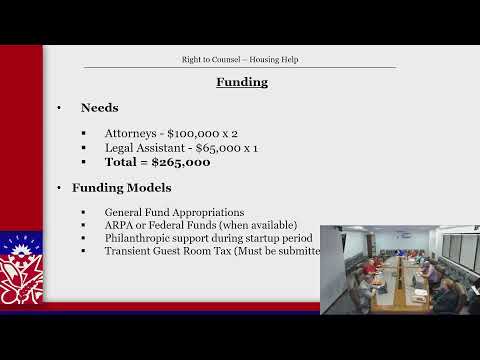
City staff and council members discussed funding models for a Norman pilot. Council members proposed a $100,000 pilot to fund one full‑time attorney focused on Norman cases, with possible supplementary support from foundations or reallocated local funds. Staff noted that occupancy/guestroom tax revenues are restricted by statute to tourism uses and might not be available for such a program without voter approval; general fund or philanthropic support were discussed as alternatives.
Legal Aid described prior ARPA‑funded pilots in the region and estimated one full‑time eviction attorney costs at roughly $100,000 a year; multiple attorneys and support staff would scale costs accordingly. Council members expressed interest in returning to oversight with a proposal that outlines scope, partners (possible OU clinic involvement), priorities (e.g., seniors, families with children), and precise budget requests.
No formal funding decision was made; council asked staff to explore pilot design and potential funding sources and to return with a proposal.