
Staff frames vehicle-miles-traveled policies for Plan Spokane 2046; long-term goal suggested at 5—10% reduction
Get AI-powered insights, summaries, and transcripts
Subscribe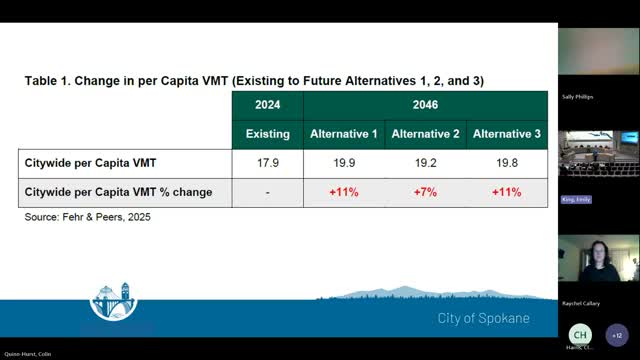
Summary
Staff presented draft Plan Spokane 2046 transportation policies that fold in HB 1181 climate requirements and a VMT analysis; modeling shows near-term per-capita VMT is likely to rise but staff recommended a realistic long-term per-capita VMT reduction goal of 5—10% and further code-based targets and monitoring.
City planning staff presented draft transportation policies for Plan Spokane 2046 that incorporate vehicle-miles-traveled (VMT) analysis and state-directed climate planning guidance, and outlined short- and long-term strategies to reduce per-capita driving.
The presenter said consultant modeling and Department of Commerce guidance under HB 1181 informed the policy options. He described three land-use and growth alternatives: stay-the-course; distributed/balanced growth focusing on mixed-use centers and transit corridors (for example Division and Wellesley); and a center-city alternative that concentrates growth downtown.
The modeling, staff said, shows VMT per person is expected to increase in the near term because the city will add about 20,000 residents and many trips will originate in greenfield areas and neighboring jurisdictions. "Long term, a realistic target for Spokane is a 5 to 10% reduction from existing levels," the presenter said, noting staff's recommendation that any specific numeric target be set in code so it can be updated without a full comprehensive-plan amendment.
Staff outlined complementary strategies that will be needed to meet VMT goals: reduced parking requirements, transit service improvements, active-transportation investments, travel-demand-management funding and coordination with regional partners for better VMT data and monitoring. The commission and staff agreed the next step is reconvening the transportation subcommittee and bringing a revised chapter back to the plan commission.