
City presents two restriping options for Grand Boulevard; commissioners favor the safer three-lane layout
Get AI-powered insights, summaries, and transcripts
Subscribe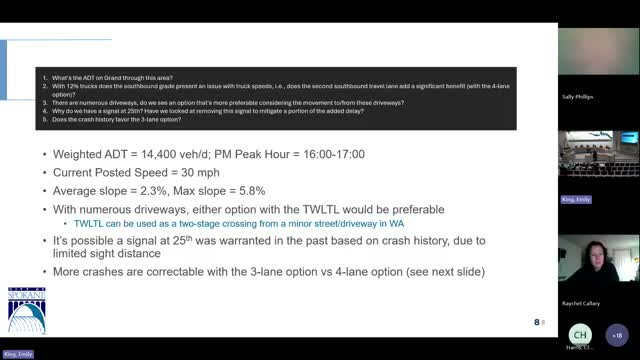
Summary
Staff presented two alternatives for Grand Boulevard: converting four travel lanes to three with a two-way left-turn lane or an uphill two-lane configuration that retains four lanes. Staff said the three-lane option is the safer, cheaper way to add pedestrian crossings but would increase travel time modestly; design work is expected next year with construction expected no later than 2027.
City staff presented two design alternatives for restriping Grand Boulevard to add a center turn lane and improve safety, and commissioners expressed a clear preference for the option staff described as the safer outcome for pedestrians.
"This one's the safest option for pedestrians," Brian Brisendine of Integrated Capital Management said of the three-lane conversion that would create a two-way left-turn lane and single travel lane in each direction. He said the route carries about 14,400 vehicles per day and includes a significant truck share, which informed lane-width and design considerations.
Brisendine summarized tradeoffs: the three-lane option increases corridor travel time by about 58 seconds on average but simplifies crossings and allows lower-cost crossing treatments such as a rectangular rapid-flashing beacon; the alternative maintains two uphill lanes and increases uphill travel time by roughly 30 seconds while requiring more expensive pedestrian hybrid beacons or refuge islands at some crossings. Staff also noted STA bus stops and large truck turns as design constraints that shaped lane-width choices and slip-lane geometry.
Commissioners asked about specific intersections, truck swing needs, and whether a targeted uphill bus lane or other transit-first approaches had been discussed. Multiple commissioners voiced support for the three-lane option as the safer choice and urged staff to preserve wider lane widths where STA buses and freight require them.
Staff recommended returning with additional design detail and said a public hearing could be scheduled in the coming months; design work would occur next year with construction expected no later than 2027 under current scheduling assumptions.