
Spokane staff outline how new commercial parking tax will be used, flag exemptions and next steps
Get AI-powered insights, summaries, and transcripts
Sign Up Free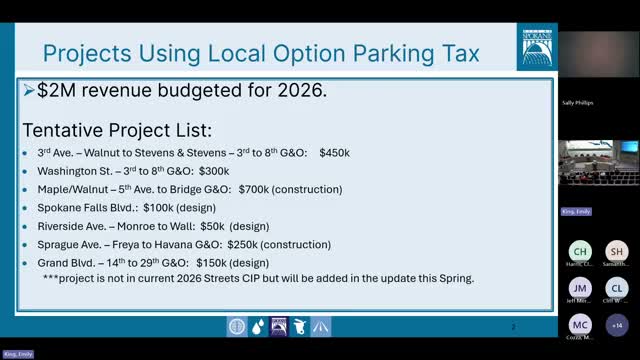
Summary
City staff told the Transportation Commission the local commercial parking tax could bring roughly $2 million in its first (partial) year and be used mainly as local match for grant-funded capital projects; staff also described exemptions for designated 30+ day reserved stalls, carpools, handicap placards and government vehicles and launched a public-rule process for implementation.
The Spokane Transportation Commission heard a staff briefing on the newly adopted local option commercial parking tax and initial project priorities, with officials saying the tax will be implemented beginning April 1, 2026 and could generate roughly $2,000,000 in its first (partial) year.
"The estimated revenue that the tax will bring in in the first year is roughly $2,000,000," Kevin Picasso of Integrated Capital Management told the commission. Staff said most of the projects identified for the tax proceeds are already in the city's capital improvement program and that the parking tax would often serve as local match for grant-funded work.
Mayor's policy advisor Adam McDaniel described the ordinance's two related components: an efficient land-use credit to lower the rate for eligible developments and a set of exemptions beyond state law. "If you have two or more floors of parking or below-ground parking, or a complete building permit, you're eligible for essentially half the imposed rate," McDaniel said, describing the credit as an incentive to redevelop surface parking lots into housing.
Staff said state law provides three statutory exemptions (carpools, vehicles with disability placards and government vehicles) and that the city's proposed rules would add limited local exemptions intended to align with the state's excise-tax advisory (for example, parking rented for 30 days or more that is treated as rental real estate). McDaniel said the intent is to make collection and administration easier for commercial parking operators.
Downtown Spokane Partnership liaison Emily Cameron cautioned that, as currently drafted, many reserved residential or employee parking arrangements would still fall under the tax. "In most residential reserved areas in off-street parking, it is a lot that residents have the right to use, but it's not resident A gets space A ... the way it's structured right now, most would actually be paying that tax," Cameron said, urging staff to use the public-rule process to clarify definitions.
Commissioners asked whether the tax revenue could be used for full residential-street rebuilds; staff replied the source is flexible for transportation capital purposes and will be evaluated alongside other funding tools. Staff said the next steps are the public-rule process to finalize exemptions, development of implementation guidance and continued coordination with parking operators and affected stakeholders.
The administration emphasized the tax is a partial-year revenue source in 2026 and that final allocations and program rules will return to the commission for additional input before funds are committed.