Get Full Government Meeting Transcripts, Videos, & Alerts Forever!
Get email alerts on the Inclusionary Housing topic
No spam. Unsubscribe anytime.
Planning Commission backs 10% inclusionary requirement and local preference policy for new large projects
Summary
The Planning Commission recommended that City Council adopt ordinance amendments creating Chapter 17.27 and revising 17.18.03 to require residential projects of 20+ units to set aside 10% of units as affordable (with specified AMI targets), implement a local live-work preference for city-funded or city-entitled BMR units, and provide multiple alternative compliance options; the recommendation passed unanimously.
The Planning Commission voted unanimously to recommend City Council adopt amendments to Newark Municipal Code section 17.18.03 and add a new Chapter 17.27 that would apply an inclusionary housing requirement to large residential projects and codify a local preference policy for certain below-market-rate (BMR) units.
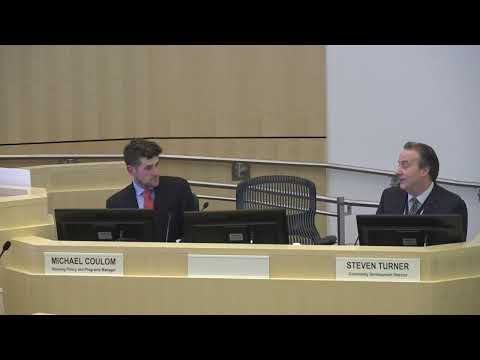
Michael Coolum, the city's housing policy and programs manager, said the changes implement elements of the city's 6th-cycle housing element and respond to a displacement study showing a decline in lower-income households and rising rent burdens in Newark. Under the staff recommendation, residential projects with 20 or more units would be required to set aside 10% of units as affordable or seek an alternative means of compliance. For rental projects, the recommended affordability mix would average 50% of area median income (AMI), and for ownership projects affordable units would average 110% AMI (with no unit above 120% AMI). Affordable units would be recorded for 99 years and subject to monitoring.
Consultants from Community Planning Collaborative and Century Urban presented feasibility work and developer outreach that informed the proposal. Their prototype analysis and stakeholder interviews produced a recommendation that a 10% on-site set-aside balances the city's affordability goals and project feasibility under current market conditions. The staff proposal also includes five alternative compliance options: a large-project in-lieu fee (subject to Council approval), clustered affordable units, off-site construction, site dedication, or another mutually agreed method documented in an affordable housing agreement.
Commissioners queried whether developers had reviewed the 10% proposal and whether the set-aside would materially change developers'ability to finance projects. Consultants said target-return assumptions were shared with developers and that the 10% scenario produced outcomes similar to the city's existing housing-impact-fee approach for many prototypes. Commissioners asked staff to continue assessing the cumulative effect of impact fees and to consider fee adjustments to preserve feasibility. Coolum said the city has about $49.6 million in its affordable-housing fund, with approximately $19.3 million uncommitted, and that City Council could consider the commission's recommendation as early as Jan. 8; if adopted the ordinance would take effect 30 days later.