CDOT previews HSIP NOFO, signals $21M local allocation and Feb. 20 application deadline
Summary
Colorado Department of Transportation officials told the DRCOG safety working group they will release a NOFO for the Highway Safety Improvement Program (HSIP) early next week, with a webinar tentatively Jan. 20, applications due Feb. 20 and award notifications by April. Local agencies will be prioritized under the competitive call.
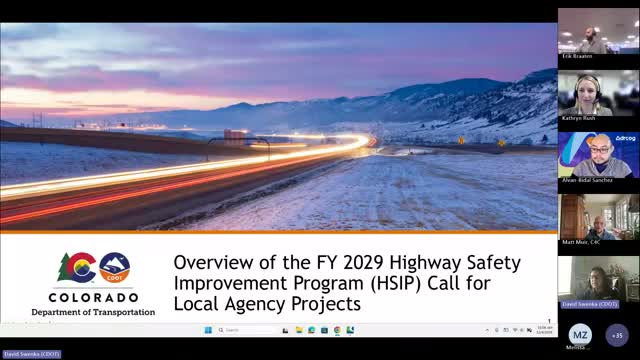
David Swenka of the Colorado Department of Transportation outlined the state’s annual call for Highway Safety Improvement Program (HSIP) local‑agency projects and the schedule for the coming funding cycle. He said CDOT expects the local allocation for state fiscal year 2029 to be about $21,000,000 and that the NOFO will be distributed to the usual list “early next week.”
CDOT will host a webinar for applicants tentatively on Jan. 20, 2026; formal applications are scheduled to be due Feb. 20, 2026, and awards will be announced by April, Swenka said. He advised applicants they may include design costs in requests and indicated CDOT typically sees more competitive pressure on the Front Range than on the Western Slope.
Why it matters: HSIP is a federal program intended to reduce fatalities and serious injuries on public roads. Swenka said roughly half of Colorado’s traffic fatalities and serious injuries occur on non‑state (local) roadways, which is why CDOT prioritizes local‑system projects in this NOFO.
Key details presented
• Funding and match — CDOT projects about $21,000,000 for local‑agency projects in SFY 2029. HSIP projects require a 10% match (state or local) and CDOT typically splits total HSIP funding roughly 50/50 between state and local systems. Swenka said Region 1’s local allocation is about $11,100,000 out of the total estimate.
• Prioritization and eligibility — Swenka emphasized that local roadway safety projects submitted through this competitive call will be prioritized above state‑highway submissions. Applications first pass a screening for level‑of‑service‑safety and crash patterns; site‑specific projects generally require a minimum benefit‑cost ratio (BCR) of 1 to be considered.
• Systemic projects and set‑asides — CDOT defines systemic projects as treatments across many locations (for example, the same countermeasure applied to multiple crossings). The department plans a 25% systemic set‑aside by region, with typical systemic project awards capped at about $500,000 (low‑cost countermeasures are the primary focus of systemic funding).
• Special rules — Colorado must meet FHWA special‑rule obligations for vulnerable road users (VRU) and high‑risk rural roads. Swenka said the state intends to obligate about 15% of HSIP toward VRU projects and allocate approximately $2,800,000 for the high‑risk rural roads requirement in the coming year.
• Practical application tips — Applicants should include a basic cost estimate with submissions and consider systemic applications if short corridor lengths make site‑specific BCRs hard to demonstrate. Swenka said CDOT will assist agencies with prescreening if needed but that online BCR tools for local roadways are not currently available.
Examples and follow‑up
Swenka cited past HSIP awards (shoulder widening and guardrail in Douglas County, roundabouts and pedestrian upgrades in cities including Englewood and Westminster) to show the range of eligible infrastructure. He also said CDOT reviews project delivery history when ranking awards and asked agencies to report if previously awarded projects remain behind schedule.
The NOFO, application materials and the webinar invite will be distributed by email and posted on CDOT’s HSIP webpage; Swenka invited agencies that do not receive distribution notices to contact his group to be added to the list.
Next steps: CDOT will publish the NOFO early next week, hold the applicant webinar in January and begin reviewing applications after the February deadline.