
District receives AB 2158 ethics training on conflicts, Brown Act and gift rules
Get AI-powered insights, summaries, and transcripts
Subscribe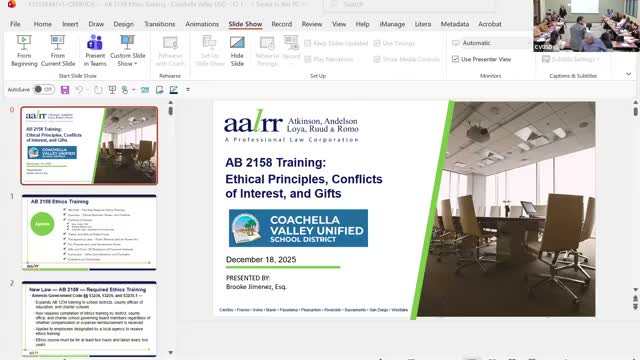
Summary
Coachella Valley Unified trustees received a multi-hour AB 2158 ethics training covering Gov. Code §1090 (contracts), the Political Reform Act, Brown Act transparency rules, Form 700 gift-reporting (threshold $630) and new required fiscal training starting 2026.
Coachella Valley Unified trustees and senior staff took part in a multi-hour ethics training delivered by Brooke Jimenez, an attorney leading the Riverside office of her firm, focused on recent and upcoming changes to state ethics and transparency laws.
"Today, we're gonna, you know, complete the required AB 21 58 training concerning, ethics for, governing board members as well as other agency officials," Jimenez said as she introduced the session, which reviewed statutory conflict-of-interest rules and new training deadlines.
Why it matters: AB 2158 requires covered agency officials to complete two hours of ethics training every two years. Jimenez told trustees who serve as of Jan. 1, 2025, they must complete two hours by Jan. 1, 2026, and she flagged an additional two-hour fiscal/financial training requirement that will apply beginning Jan. 1, 2026.
Key legal standards: The presenter contrasted the government-code contract ban, commonly cited as Gov. Code §1090, with the Political Reform Act (PRA). "The PRA governs decisions made, so there's a distinction there," she said, explaining that §1090 targets officials who are financially interested in contracts while the PRA covers a broader set of governmental decisions and includes a reach-back look at developing economic interests.
Practical compliance: Jimenez urged written disclosures and formal recusals when a disqualifying interest exists and recommended seeking an FPPC opinion when facts are uncertain. "You must publicly identify the financial interest that gives rise to the conflict in sufficient detail to the public," she said, describing the PRA's disclosure and recusal steps.
Gifts, reporting and penalties: The training reviewed Form 700 reporting rules and thresholds. Jimenez summarized that gifts or meals valued at $50 or more from a single source must be recorded and that the annual aggregate limit for 2025–2026 is $630 per source; failing to report may prompt FPPC enforcement and civil or criminal penalties. She also explained the Form 801 process for donations given to the agency rather than to an individual official.
Pay-to-play and permit proceedings: Jimenez reviewed the Levine Act/pay-to-play rules, describing a $500 contribution limit from a party or participant to certain officials for 12 months before and after an entitlement decision. She noted narrow exceptions — for example, competitively bid contracts and certain labor agreements — and the new return-or-repay window that can, in some cases, preserve participation.
Open-meeting and records obligations: The presenter reiterated Brown Act requirements, including posting timelines (72 hours for regular meetings, 24 hours for special meetings) and the broad definition of a meeting (majority communications and "serial meeting" risks). She also discussed CPRA obligations and explained that records on personal devices used for official business may be subject to public-records requests.
Enforcement and examples: Jimenez described potential consequences for willful violations under §1090, FPPC civil fines under the PRA, and criminal exposure in severe cases. She cited past local-government enforcement examples and recommended cautious, documented practices for travel, hospitality and vendor interactions.
Procedural note: The board approved the meeting agenda before the training in a motion moved by Trustee Erano and seconded by Garcia; the motion passed with a recorded tally of five in favor, zero opposed and zero abstentions. At the end of the instructional session, Jimenez said attendees would receive certificates of participation to demonstrate compliance with AB 2158.
What happens next: The presenter offered to remain available for additional questions and to support trustees and staff in obtaining FPPC guidance or amending disclosure forms if needed. The training materials and recommended policy language discussed during the session were noted as resources for board review.