
Phoenix outlines $1.96M SmartGrant pilot to cut pedestrian delay and red-light running
Get AI-powered insights, summaries, and transcripts
Subscribe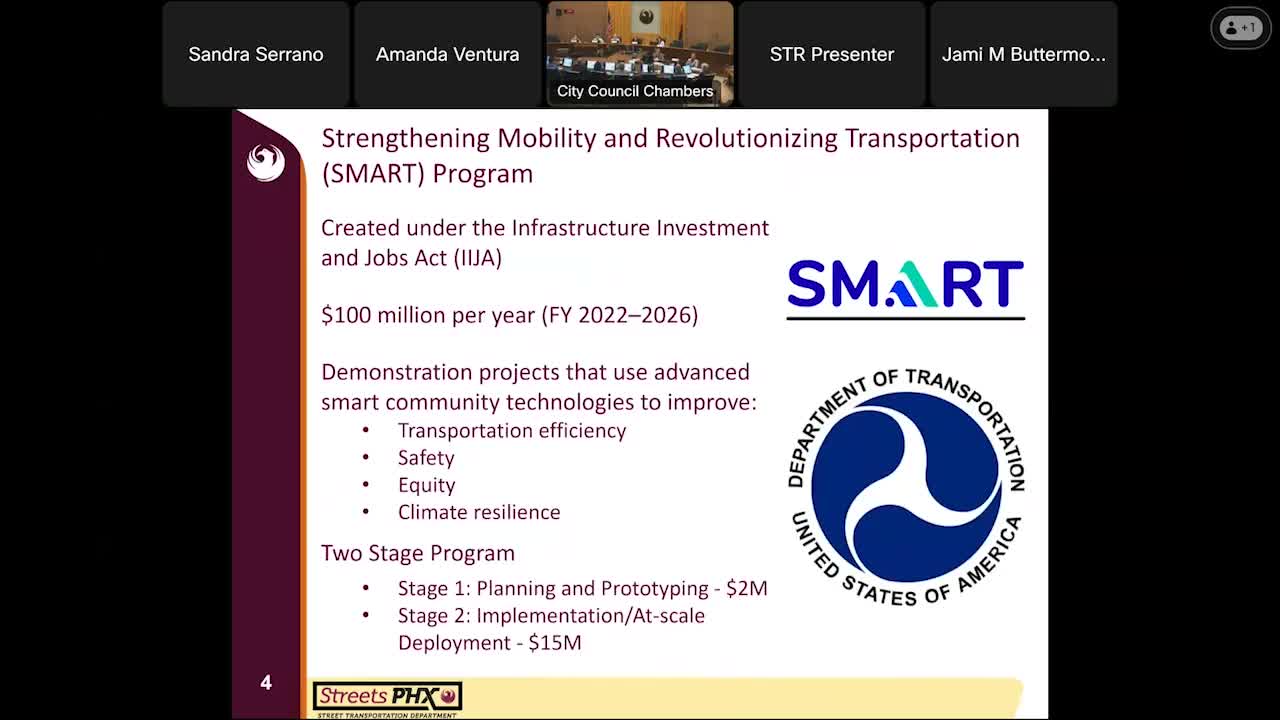
Summary
Street Transportation staff described a federally funded stage‑1 Smart Grant pilot using advanced detection and video analytics at about 30 intersections to reduce pedestrian delay at HAWK crossings and detect red‑light running; stage‑2 funding could scale the tech to 100+ locations. Cost per HAWK detection was estimated at $30,000–$35,000.
Simon Ramos, traffic engineering supervisor in the City of Phoenix Street Transportation Department, briefed the subcommittee on a stage‑1 Smart Grant pilot that tests intelligent transportation systems (ITS) technologies at roughly 30 intersections.
Ramos said the pilot — funded under the Infrastructure Investment and Jobs Act (commonly called the Bipartisan Infrastructure Law) — awarded Phoenix approximately $1,960,000 for stage‑1 planning and demonstration work with vendors NoTraffic and Iteris and partners including Maricopa Association of Governments and the University of Arizona. "We were awarded 1,960,000.00 for the stage 1," Ramos said.
The pilot applied passive and advanced detection at HAWK (pedestrian hybrid beacon) locations along the Grand Canal and lane‑by‑lane no‑invasive detection on arterial segments near a Glendale Avenue pilot. Staff reported an observed reduction of about 50% in pedestrian wait time at treated HAWK locations when passive detection and revised timing strategies were applied, and described the project’s broader tools: smart detection cameras, red‑light running validation via video analytics, virtual detector zones for end‑of‑queue and near-miss data, and bike confirmation lights.
Committee members asked whether the extra pedestrian time is applied to the WALK or the flashing DON'T WALK interval; Ramos said in some locations a hold‑button option applies extra seconds to the WALK interval but in many locations the extension is applied during the flashing DON'T WALK interval. Asked about cost, Ramos estimated the additional detection system per HAWK at roughly $30,000–$35,000.
Ramos said stage‑2 funding decisions were still pending; if awarded, stage‑2 would support a multi‑year roll‑out (36 months) that could expand the technology to dozens more HAWKs and signals, with staff estimating annualized safety and travel‑time benefits across the network. He noted estimated annual savings from treated HAWKs and signal locations in the low millions when combining reduced crash costs and travel‑time savings, and said the department plans to report enforcement and operational metrics as the project matures.
The committee praised the pilot’s pedestrian-delay measurement and asked for continued monitoring; staff said they will return with further evaluation when available.