
Maricopa County chair touts balanced budget, public-safety spending and zoning overhaul in year-end address
Get AI-powered insights, summaries, and transcripts
Subscribe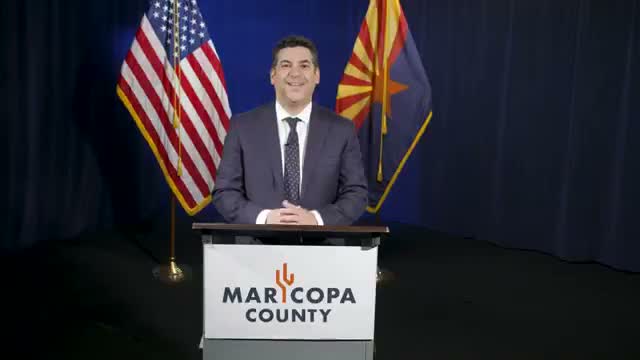
Summary
Chair Thomas Galvin used a year-end State of the County address to highlight a June balanced budget and five consecutive years of tax-rate cuts, $30 million in detention retention bonuses, a zoning-code overhaul, election-procedure reviews and new animal-care funding.
Maricopa County Board of Supervisors Chair Thomas Galvin delivered a year-end State of the County address outlining the board’s accomplishments and priorities, including a balanced budget, sustained tax cuts and increased spending on public safety and animal care.
"Our work includes a few core priorities: fiscal responsibility, public safety, economic development, housing affordability, election integrity, and animal care," Galvin said, summarizing the agenda he set when he became chair in January.
Galvin told the board that in June they passed what he described as a "fiscally sound balanced budget" and that the county has cut its overall tax rate for a fifth consecutive year. He said the county holds a strong bond rating and carries no general obligation debt. To increase fiscal oversight, he said he directed the county manager to create a budget performance-management system intended to reduce waste and improve accountability.
On public safety, Galvin emphasized recent pay increases and retention efforts for law-enforcement staff. "We approved the most significant pay raise for our deputies and officers in 15 years," he said, and noted a $30,000,000 investment in retention bonuses for detention officers who oversee jail operations.
Galvin also addressed long-running federal oversight of the sheriff's office, saying that oversight has been costly and that the county has hired a constitutional law attorney to advise on efforts to end it. He said he wrote to Pam Bondi about Justice Department oversight of Phoenix police and that her response supported the county’s position, which he said reduced the prospect of that oversight moving forward.
The chair said the county successfully lobbied the state legislature and governor to place a public-safety tax renewal on the 2026 ballot, calling the funding "an essential financial resource that has kept our community safe for decades." He described that referral to the ballot as a milestone for local public-safety funding.
On economic development, Galvin said he launched the county’s first economic development office and cited meetings with federal officials about air-quality policy; he also said he advocated for progress on Interstate 11 and for a long-term solution to keep Chase Field and the Arizona Diamondbacks in the region. Galvin described workforce-retention efforts, including new "Rising Star" awards for county employees.
Turning to housing, Galvin said he convened a housing roundtable and oversaw a major revision of a county zoning ordinance, which he said removed roughly 15,000 words and consolidated redundant sections to make rules easier to use and to expand housing opportunities.
On elections, Galvin said the county administered four elections this year and completed a comprehensive procedural review of election administration "to strengthen transparency, accuracy, and voter confidence." He framed continued openness to improving the voter experience as a priority.
Animal care was another theme: Galvin said the county secured funding for a new West Valley shelter and is launching a nonprofit, Friends of Animal Care and Control, to raise private funds for veterinary care, spay-and-neuter services and community programs.
Galvin closed by thanking his board colleagues — Vice Chair Kate Brophy, McGee, Debbie Lesko, Mark Stewart and Steve Gallardo — along with County Manager Jen Pokorski and named staffers, and said serving as chair "has been a tremendous honor." He said he is confident his successor will continue the county’s work into the coming year.
What happens next: Galvin identified several ongoing items — the 2026 public-safety tax renewal on the ballot and continued implementation of budgeting and personnel initiatives — but did not provide specific timelines for many of the programs he described.