
Greece Central presents special education annual report, warns of space and service gaps
Get AI-powered insights, summaries, and transcripts
Subscribe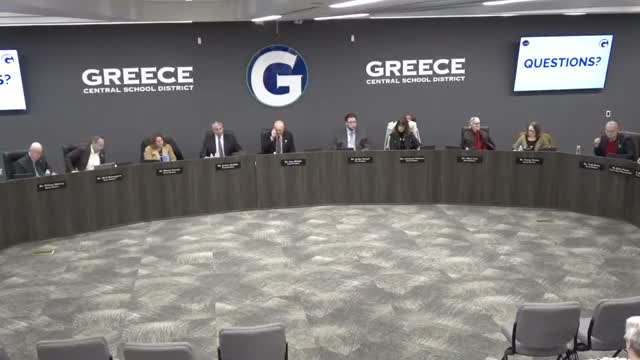
Summary
District special education leaders reported 1,700+ students receiving special education services (about 17.5% of enrollment), described program breadth and staffing, and warned that physical space—more than staffing—is the main constraint limiting placement capacity and timely preschool services.
Executive Director Stacy Brindisi and Director Melanie Stevenson told the board the district operates an extensive special education continuum — roughly 84 self-contained classrooms K–12 and integrated co-teaching across most campuses — and that enrollment in special education programs has grown to more than 1,700 students, about 17.5% of the district population.
Brindisi said Greece employs about 186 certified special education teachers plus related-service staff and that approximately 691 students are in integrated co-teaching placements K–12. She noted the district provides in-district services for resident students and also oversees 99 out-of-district placements and about 83 parentally placed students within district boundaries. Brindisi flagged that the district remains cited on a federal/state indicator (indicator 4) for disproportionate suspension rates among students with disabilities and Black students with disabilities, and said the district is taking steps — improved documentation, alternatives to suspension, and focused interventions — to address the citation.
Melanie Stevenson described priority areas: strengthening MTSS/RTI and building-level problem-solving teams, professional development in explicit instruction (including Orton-Gillingham training), expansion of Readopia and other literacy supports for students who take the alternate assessment, TCI (Therapeutic Crisis Intervention) focus, and continued attention to accurate documentation and mandated timelines for case actions.
Board members asked detailed operational questions about classification trends, declines in certain specialized ratios, preschool early-intervention wait lists, and whether districts or county providers are identifying students earlier. Brindisi and Stevenson said the immediate capacity bottleneck is physical space for special classes; they reported persistent vacancies in some related-service positions and noted that county early-intervention services are limited, which pushes responsibility to the district. "We just don't have the room for our kids," Brindisi said, adding the district will share a facilities 'bubble' analysis with superintendent's cabinet after the holiday break.
The district described modest progress on its compliance assurance plan, including fewer unnecessary removals, more alternatives to suspension, and improved documentation of manifestation determinations and service continuations during suspensions. Officials said work on declassification rates remains a challenge (five declassifications so far this year) and that improving early intervention and preschool capacity is a priority.
The board took the presentation for information and directed staff to continue work on space planning, staffing pipelines, and compliance documentation.