
State Water Board outlines Safer program goals and funding priorities, sets 2030 compliance target
Get AI-powered insights, summaries, and transcripts
Subscribe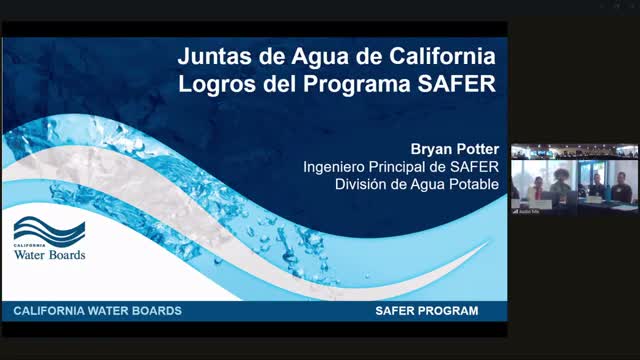
Summary
State Water Resources Control Board staff reviewed the Safer small-systems program, saying it aims to return roughly 90% of systems listed as failing in 2019 to compliance by 2030 and outlined roughly $1.32 billion in anticipated funds and related priorities for technical assistance and consolidation.
Bridal Potter, a presenter from the Division of Drinking Water with the State Water Resources Control Board, told advisory-group members the board’s Safer program is prioritizing small, failing drinking-water systems for consolidation and technical assistance.
"Nuestra meta es tener el 90 por 100 de sus sistemas que regresen cumplimiento para el año 2030," Potter said during the presentation, summarizing the program’s central target. Staff presented counts and impact estimates for the 2019 “cut”: 366 systems were identified in that category and the presenter said those systems affected more than 1,000,000 people, with roughly 630,000 people served by systems that have since returned to compliance.
Staff described the program workflow and metrics used to track projects. Division of Financial Assistance staff reported active work plans for hundreds of small-system projects, and said an average system that discharged from the failing list returned to compliance in roughly 5.5 years under current practice. The board identified technical assistance, consolidation with larger systems and targeted construction funding as the primary levers to reduce future failures.
In a separate budget overview, presenters said the program expects roughly $1.32 billion in anticipated funds across multiple sources for the coming budget year and noted other dedicated pots including a roughly $320 million pool and about $400 million of general-obligation-like funding described in the presentation. Staff said additional targeted financing — roughly $330 million cited for regional projects — and increased technical-assistance dollars would support construction and operations for consolidated systems.
Why it matters: small systems often face higher per-customer costs and technical complexity. The board framed consolidation and steady technical support as ways to lower bills and increase long-term system sustainability, while tracking outcomes by staged project status from planning to construction.
What’s next: staff said program tracking and community outreach will continue, with priority-setting for funds and expanded technical-assistance efforts to accelerate projects currently in design and construction.